Saturday, August 25, 2012

James Price Point: Environmental Significance Ignored in Failed Impact Assessment

James Price Point S34964
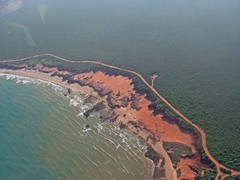
James Price Point S34964 (Photo credit: yaruman5)
by Malcolm Lindsay, PhD Candidate at University of Melbourne, The Conversation: theconversation.edu.au

The proposed Browse Liquefied Natural Gas Hub at James Price Point (known locally as Walmadany), 50km north of Broome, has created one of the most fiercely fought environmental and indigenous battles currently occurring in Australia.

Despite the existence of alternative brown field sites (such as Karratha), the State Government prefers James Price Point even though it is likely to be a far more expensive option (an estimated $15 billion) for joint venture partners Woodside, BP, BHP, Shell and Mitsui/Mistubishi, and tax payers.

The James Price Point option is also far more pristine, biodiverse and ecologically significant, with a rich indigenous connection to country. The area is abundant with indigenous songcycle pathways, burial grounds, the Lurujarri Heritage Trail, calving Humpback whales, dugongs, dolphins, abundant fishes, coral reefs, seagrass, remnant rainforest, dinosaur trackways and breeding bilbies.

The area is so ecologically and culturally rich that it was recommended for National Park protection by the Australian Academy of Sciences and the National Parks Board of WA in 1962; the WA Environmental Protection Authority in 1977 and 1993; the WA Department of Conservation and Land Management in 1991; the Broome Shire, Department of Land Administration and WA State Cabinet in 2000; and the Broome Planning Steering Committee in 2005.

This is all at odds with the state premier Colin Barnett’s description of the area as an “unremarkable” piece of coastline.
Despite all the recommendations for protection, James Price is the state government’s preferred option. It therefore requires an environmental impact assessment of whether the gas hub could proceed without significant, severe and long lasting impacts on the local environment.

The WA Environmental Protection Authority (EPA) recently completed an initial assessment. A further assessment is due from the Federal Environment Minister at the end of the year. The WA EPA based their assessment on the Strategic Assessment Report (SAR) prepared by the state government for the project, giving the project the green light.

As the proposed gas hub is one of the largest industrial projects in Australia’s history and will become the largest gas hub in the world, one would expect the environmental impact assessment to be well considered, comprehensive, robust and based on sound science. Unfortunately the EPA’s assessment fell far below these expectations.

Major issues occurred in the assessment process itself. The state government recognised that - due to the scale and complexity of the project - they’d need a high level of confidence in the science underpinning the SAR. They recommended establishing a peer review process. This didn’t happen: only the minority of the science was scrutinised and only when major inadequacies were revealed by independent and citizen scientists.

This leaves little confidence and much uncertainty in the quality of the SAR’s science on which the EPA based their assessment. When the assessment was undertaken, four out of five EPA board members had to be excluded due to conflicts of interest, leaving a “quorum” of one.

As three of these conflicted members were excluded only months before the completion of the five year assessment, there was ample opportunity for their conflicts to influence the process.

Despite these procedural issues, how did the EPA justify impacts to the significant ecological communities and species of James Price Point? For brevity I will focus on two of the most significant ecological features of the area.

One of the most striking and significant ecological features of the James Price Point area is the monsoon vine thicket that occurs behind the coastal dunes. This little-studied remnant rainforest is incredibly diverse, containing 25% of all plant species from the Dampier Peninsula and up to 70 species of ants.

This rainforest also contains one of the highest densities of bush tucker and medicinal plants in Australia and is therefore critically significant to the local indigenous people. Poor fire management, weeds and land clearing have led to fragmentation and declines in these communities. The communities are currently under assessment for federal listing as a threatened ecological community.

To read further, go to: http://theconversation.edu.au/james-price-point-environmental-significance-ignored-in-failed-impact-assessment-8817?utm_medium=email&utm_campaign=Latest+from+The+Conversation+for+23+August+2012&utm_content=Latest+from+The+Conversation+for+23+August+2012+CID_50f943b8e72296edeba130463220fa19&utm_source=campaign_monitor&utm_term=James+Price+Point+environmental+significance+ignored+in+failed+impact+assessment
Enhanced by Zemanta

Friday, August 24, 2012

Scientists Wary of Wearing Their Hearts on Their Sleeves - Is This What We Really Want?

English: Flowchart of the steps in the Scienti...
Flowchart of Scientific Method (Wikipedia)
by Dr Susan Lawler, Head of Department, Department of Environmental Management & Ecology at La Trobe University, The Conversation: theconversation.edu.au

A reader complained that my last column about the environmental damage caused by super trawlers was too emotive.

We agreed about the facts, but not about how to frame them.

I tried to ignore this comment, but it kept bothering me, and for different reasons on different days.

After some rumination, and conversations with colleagues, I have decided to address it. Must serious conservationists avoid using their hearts? Do we do better science when we only use our brains? Is our advocacy for the planet best framed in dry factual statements? I think not, and my reasons are varied.

Reason one: science communication often suffers from a lack of emotive content. Yesterday, a colleague sent me a link to an article called three tips for science communication, in which the author complains: "It dismays me how scientists - so full of passion and creativity - sometimes make the wondrous mundane, and the story of their work stripped of emotion.”

Part of my life’s goal is to share my enthusiasm for science and the species with whom we share our planet, and being told that I need to be wary of wearing my heart on my sleeve is frustrating. I want to keep my heart where it belongs, right here in my chest, but I want it to be part of my work.

Otherwise, how can I convince non-scientists that I speak from a place of truth and honour? My integrity is firmly embedded in my passion for this thing called life.

Reason two: science is more fun than most people realise. I know from personal experience that scientists are passionate, emotional creatures. We get really excited about apparently esoteric stuff, but when we explain it, we get our students, friends and families excited too.

I have often been on field trips where we meet unique, endangered creatures, and the students do not realise how special the moment is until the senior staff’s excitement becomes apparent. If scientists do not share their emotional responses, they are not truly teaching.

Scientists, like everyone else, do better work when they put their whole person, body and soul, into their work. The world needs more people to learn and use the scientific method, but this won’t happen if people think they have to check their hearts at the door. If we portray ourselves as merely walking brains, how are we going to convince others to join us, and become scientists, too?

Reason three: my environmental students are afraid of being labelled as greenies. I think this is the crux of the problem. Young people who want to save the planet and protect our environment enrol in a degree in science so that they will have the knowledge and credentials to make a difference. But to do this they feel they must reject the extremes of some in the environmentalist movement.

I can illustrate the problem with a conversation I had about a year ago. I rang someone (in government or industry, I forget the exact issue) and introduced myself as a conservationist. The person on the other end began with, “You people”… and began to tell me what I thought, almost none of which was true.

When I managed to break in and explain that I was a scientist who had been doing research in the area and had hoped to offer some useful suggestions, the individual calmed down and said, “Oh! You mean that you are a conservationist!” … as if I should have said so. Except that I had.

Conservationists are therefore somewhat twitchy, and as a group we are schizophrenic. We feel compelled to express our concerns about the environment in a way that distances us from other people who care about the environment. Some of us work from a scientific framework, base our arguments in logic, and seek solutions that are acceptable to society.

Others are looking for fundamental changes to society as we know it, and are willing to take radical actions including vandalism. Most environmentalists are somewhere in between.

To read further, go to: http://theconversation.edu.au/scientists-wary-of-wearing-their-hearts-on-their-sleeves-is-this-what-we-really-want-9016?utm_medium=email&utm_campaign=Latest+from+The+Conversation+for+24+August+2012&utm_content=Latest+from+The+Conversation+for+24+August+2012+CID_e9b2fff041b8ed43e695f1be95bfcdb3&utm_source=campaign_monitor&utm_term=Scientists+wary+of+wearing+their+hearts+on+their+sleeves+--+is+this+what+we+really+want
Enhanced by Zemanta