Tuesday, July 31, 2018

The U.S. Government Tried to Stop These Kids' Lawsuit Over Climate Change - It Didn't Work

by Annie Reneau, Upworthy: https://www.upworthy.com/the-u-s-government-tried-to-stop-these-kids-lawsuit-over-climate-change-it-didn-t-work?c=upw1

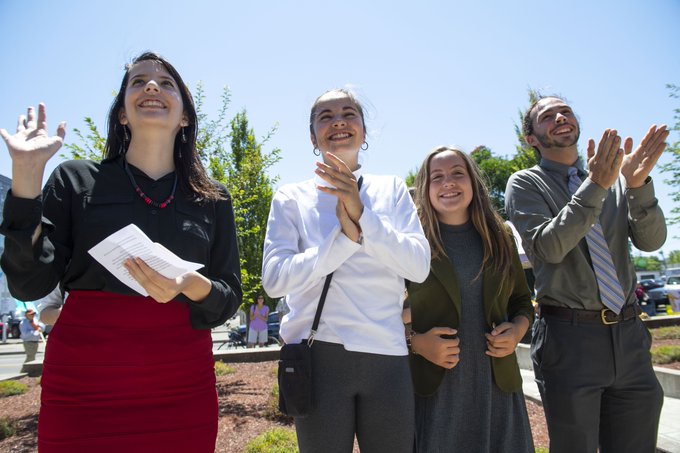
Since 2015, 21 young people aged 8 to 20 have been engaged in Juliana v. the United States, a lawsuit over climate change.

The plaintiffs argue that the federal government has not taken sufficient action to battle catastrophic climate change and that the dire future of the planet infringes on their constitutional right to life, liberty, and the pursuit of happiness.
They contend that the government has known for decades how carbon dioxide pollution and the greenhouse effect affects the Earth, yet has failed to take action to save future generations from those effects.

In fact, these kids say, the government has actually taken actionable steps to make climate change worse and has "failed to protect essential public trust resources."
As Earth Guardians — a youth-led environmental group and organizational plaintiff in the lawsuit — states, "We're holding the federal government accountable for putting our future at risk and refusing to act on climate change."

The government, under both Obama and Trump, has made multiple attempts to get the lawsuit tossed out.

Juliana v. U.S. was filed during the Obama administration and has carried over into Trump's tenure. Both administrations have attempted to have the lawsuit dismissed before it reached trial, and unsurprisingly, fossil fuel industries have attempted to join in the effort.
However, the court system rejected the government's appeals to drop the case in April 2016November 2016, and June 2017. A judge also issued an order in June 2017 that removed the fossil fuel defendants from the case.
Still, the government persisted, with a "drastic and extraordinary"attempt to have higher courts intervene in those judges' decisions. Though ultimately unsuccessful, their actions succeeded in delayingthe original scheduled trial date of Feb. 5, 2018.

However, an appeals court again ruled in favor of the kids, finally giving them their day in court.

In a final plea in summer 2018, the government tried again to get a higher court to intervene and put a swift end to the lawsuit, claiming that letting the case go to trial would be too burdensome on the government and would unconstitutionally pit the judicial and executive branches of government against one another.


BREAKING: Ninth Circuit Rules in Favor of Youth Plaintiffs Again, Denies the Trump Administration’s Second Petition for Writ of Mandamus in Juliana v. United States. Read the full press release here: https://www.ourchildrenstrust.org/s/20180720-Press-Release-on-Ninth-Circuits-Second-Decision.pdf 
But on July 20, three judges in the Ninth Circuit Court of Appeals unanimously voted to allow the case to continue, stating that such arguments were better decided in court. The kids and their lawyers are scheduled to begin trial on Oct. 29 in a federal court in Eugene, Oregon.

Once again, young people are engaging in civic action to make change in their world. Hallelujah!

Suing the federal government may seem like an extreme move, but climate change is an undeniably urgent reality — one this young generation will bear the brunt of.
Thankfully, kids and teens keep proving over and over that they are ready and willing to take collective action to protect their future, no matter what obstacles lie in their path. It takes gumption and diligence to speak truth to power, and these youth seem to have plenty of both.
Go, kids, go. Millions of your fellow citizens will be rooting for you in October.

Monday, July 23, 2018

It Takes a Village: Saving the South-Eastern Red-Tailed Black Cockatoo is a Community Ambition

by Daniella Teixeira, Remember the Wild: http://www.rememberthewild.org.au/it-takes-a-village-saving-the-south-eastern-red-tailed-black-cockatoo-is-a-community-ambition/

The Red-tailed Black-cockatoos of Victoria’s south-west are a distinct sub-species, known as the South-eastern Red-tailed Black-cockatoo. Image: Daniella Teixeira

In Victoria’s far south-west, the Red-tailed Black-cockatoo survives in a fragmented landscape of stringybark forests within a matrix of agricultural lands. The birds here are a distinct subspecies of Red-tailed Black-cockatoo, Calyptorhynchus banksii graptogyne or the South-eastern Red-tailed Black-cockatoo, isolated from others of their kind by thousands of kilometres. Their life history is inextricably tied to the landscape of this region, which includes the adjacent areas of South Australia. They feed almost exclusively on the small fruits of stringybark and Buloke, to which their relatively small bills are starkly adapted. They nest most often in the large, deep hollows of very old River Red Gums, many of which were ringbarked in the early 1900s.
Like its fellow Forest Red-tailed Black-cockatoo in Western Australia, the South-eastern Red-tailed Black-cockatoo is endangered. Unlike its counterpart, however, the South-eastern Red-tail hasn’t adapted to any novel food sources, thanks (at least partly) to its small bill. With the population now at about 1,400 birds, the South-eastern Red-tailed Black-cockatoo is one of Australia’s most endangered Black-cockatoos. In terms of having a small population, it is second only to the Kangaroo Island Glossy Black-cockatoo, which sits at around 400 birds (and growing, thanks to an intensive recovery program).
The decline of good quality feeding habitat is thought to be the red-tail’s most significant threat. Buloke has suffered the most severe loss through direct clearing, but the roughly 58% of stringybark that remains in Victoria continues to be threatened by fire. With no sign that the birds can eat anything else, and Buloke being too slow-growing to be planted for short- to medium-term gains, the protection of stringybark is vital to the red-tail’s survival.
I began studying this population of red-tails in early 2016, as part of my PhD research. My project came from the need for better methods to directly monitor breeding, because long-term data collected by the recovery team (a collaboration of scientists, government, non-profit groups, farmers and other stakeholders) suggested a decline in the number of juveniles in the population. Direct nest monitoring by humans had proved unfeasible.
I set out for my first field trip in the spring of 2016 to find as many red-tail nests as I could, my ultimate goal being to develop a way to monitor breeding with nothing but standalone sound recorders. If it worked, this would mean, in practice, that sound recorders at nests could provide us data on breeding behaviour and nest success. To do this, I needed to understand how red-tails behave and vocalise at nests – which meant that I first needed to find lots of nests.
I had planned for months of looking for nests in forests, but I quickly learned that with the help of the farmers who are familiar with red-tails, all my work at nests could be done on private property. In fact, this proved a much more effective approach since almost all known red-tail nests are on private land, because that’s where the big, dead River Red Gums still stand. Engaging with landowners, as it turned out, became the most important tool in my nest-monitoring arsenal. So, while every PhD student dreams of fieldwork in pristine wilderness, I found myself working not in forests but on livestock farms.
Skip forward to 2018 and I have data from nests on farms across a large part of the red-tail’s range. What’s more, the farmers keep an eye on things for me when I can’t be in the field. It’s the collaboration – and enthusiasm – of the farmers along with me and the recovery team that has allowed this project to move forward.
In a broader context, community involvement is key to this bird’s recovery. While conservation actions are guided by the scientists and stakeholders that form the recovery team, the on-ground work relies on the dedicated investment from community members. Each year, volunteers get together to find red-tail flocks so that the recovery team can collect data on population size, demographics, and the flocks’ locations in the landscape that year. This provides the most important long-term monitoring data that we have for the red-tails. Landowners also volunteer their properties for food habitat revegetation and artificial nest hollow installations.
The situation seems bleak for the South-eastern Red-tailed Black-cockatoo. We know that food habitat is being impacted by fire, and we know that natural nest hollows are collapsing. While there is serious cause for concern, optimism arises from the impressive dedication that I’ve witnessed in the red-tail community. If we can better understand how well red-tails breed and where, and then use that knowledge to take actions like revegetation and installing artificial nest boxes on private land, we will have a good chance of promoting better breeding in this endangered population.

Daniella Teixeira’s research was recently featured on an episode of ABC’s Off Track. Make sure you give it a listen here.