Showing posts with label Global warming. Show all posts

Monday, October 9, 2017

The Reality of Living With 50℃ Temperatures in Our Major Cities

by Liz HannaAustralian National University, The Conversation: https://theconversation.com/the-reality-of-living-with-50-temperatures-in-our-major-cities-85315
File 20171006 9753 1kew8yg
Sydney is facing 50℃ summer days by 2040, new research says. Andy/Flickr/Wikimedia Commons, CC BY-SA

Australia is hot. But future extreme hot weather will be worse still, with new research predicting that Sydney and Melbourne are on course for 50℃ summer days by the 2040s if high greenhouse emissions continue. That means that places such as Perth, Adelaide and various regional towns could conceivably hit that mark even sooner.

This trend is worrying, but not particularly surprising given the fact that Australia is setting hot weather records at 12 times the pace of cold ones. But it does call for an urgent response.

Most of us are used to hot weather, but temperatures of 50℃ present unprecedented challenges to our health, work, transport habits, leisure and exercise.

Humans have an upper limit to heat tolerance, beyond which we suffer heat stress and even death. Death rates do climb on extremely cold days, but increase much more steeply on extremely hot ones. While cold weather can be tackled with warm clothes, avoiding heat stress requires access to fans or air conditioning, which is not always available.

The death rate in heat ramps up more rapidly than in cold. Data from Li et al., Sci. Rep. (2016); Baccini et al., Epidemiol. (2008); McMichael et al., Int. J. Epidemiol. (2008), Author provided

Even with air conditioning, simply staying indoors is not necessarily an option. People must venture outside to commute and shop. Many essential services have to be done in the open air, such as essential services and maintaining public infrastructure.

Roughly 80% of the energy produced during muscular activity is heat, which must be dissipated to the environment, largely through perspiration. This process is far less effective in hot and humid conditions, and as a result the body’s core temperature begins to climb.

We can cope with increased temperatures for short periods – up to about half an hour – particularly those people who are fit, well hydrated and used to hot conditions. But if body temperature breaches 40-42℃ for an extended time, heat stress and death are likely. In hot enough weather, even going for a walk can be deadly.

Air conditioning may not save lives

We expect air conditioning to take the strain, but may not realise just how much strain is involved. Shade temperatures of 50℃ mean that direct sunlight can raise the temperature to 60℃ or 70℃. Bringing that back to a comfortable 22℃ or even a warm 27℃ is not always possible and requires a lot of energy – putting serious strain on the electricity grid.

Electricity transmission systems are inherently vulnerable to extreme heat. This means they can potentially fail simply due to the weather, let alone the increased demand on the grid from power consumers.

Power cuts can cause chaos, including the disruption to traffic signals on roads that may already be made less safe as their surfaces soften in the heat. Interruptions to essential services such as power and transport hamper access to lifesaving health care.

Myopic planning

It’s a dangerous game to use past extremes as a benchmark when planning for the future. The new research shows that our climate future will be very different from the past.

Melbourne’s 2014 heatwave triggered a surge in demand for ambulances that greatly exceeded the number available. Many of those in distress waited hours for help, and the death toll was estimated at 203.

Just last month, parts of New South Wales and Victoria experienced temperatures 16 degrees warmer than the September average, and 2017 is tracking as the world’s second-warmest year on record.

Preparing ourselves

Last year, the Australian Summit on Extreme Heat and Health warned that the health sector is underprepared to face existing heat extremes.

The health sector is concerned about Australia’s slow progress and is responding with the launch of a national strategy for climate, health and well-being. Reinstating climate and health research, health workforce training and health promotion are key recommendations.

There is much more to be done, and the prospect of major cities sweltering through 50℃ days escalates the urgency.

Two key messages arise from this. The first is that Australia urgently needs to adapt to the extra warming. Heat-wise communities (or “heat-safe communities” in some states) – where people understand the risks, protect themselves and look after each other – are vital to limit harm from heat exposure. The health sector must have the resources to respond to those who succumb. Research, training and health promotion are central.

The second message is that nations across the world need to improve their efforts to reduce greenhouse emissions, so as to meet the Paris climate goal of holding global warming to 1.5℃.
The ConversationIf we can do that, we can stave off some of the worst impacts. We have been warned.

Liz Hanna, Honorary Senior Fellow, Australian National University

This article was originally published on The Conversation. Read the original article.

Monday, June 5, 2017

Donald Trump’s Withdrawal From the Paris Accords Is a Crime Against Humanity

Typhoon Haiyan in the Philippines - 2013 (Photo: AP)
by Mark Hertsgaard, Common Dreams: https://www.commondreams.org/views/2017/06/02/donald-trumps-withdrawal-paris-accords-crime-against-humanity

President Donald Trump confirmed his status as climate denier in chief today, guaranteeing his place in history as an enemy of both science and humanity. 

Trump’s withdrawal of the United States from the Paris Accord on climate change will not stop the rest of the world from continuing to advance toward a clean-energy future. Solar, wind, batteries, and other technologies are growing tremendously fast, rewarding investors and employing far more people than the heat-trapping fuels of the past. 

Three million Americans now work in the clean-energy sector, more than the oil, gas, and coal industries combined. California Governor Jerry Brown, who heads the world’s sixth-largest economy and a hot spot of green-energy innovation, insisted that Trump’s efforts are doomed to failure. “The momentum is all the other way,” Brown said, “and I think Trump, paradoxically, is giving climate denial such a bad name that he’s actually building the very [climate action] movement that he is [purporting] to undermine.”

But no one should pretend that it does not matter when the world’s biggest economy rejects an agreement that put unprecedented international support behind ambitious climate action. By removing rules and regulations that require polluters in the United States to change their ways, Trump’s repudiation of the Paris Accord will slow progress at the very time when humanity’s survival requires faster action than ever.

“Crimes against humanity” is a phrase to use with caution, but it fits Trump’s repudiation of the Paris Accord and indeed his entire climate policy. Timothy Wirth, who as the under secretary of state in the Bill Clinton administration negotiated the Kyoto Protocol that sought to limit global warming, has said that those who deny the well-established science of climate change “ought to be tried for crimes against humanity.” 

Wirth told The Nation after Trump’s withdrawal from the Paris Accord that he stood by his remark, adding that the president’s action was “a stunning moral abdication of responsibility to future generations.” To refuse to act against global warming is to condemn thousands of people to death and suffering today and millions more tomorrow. This is murder, even if Trump’s willful ignorance of climate science prevents him from seeing it. History will not be so blind.

Of course, the Paris Accord is far from perfect: Its emissions reductions are voluntary and do not go far enough, at least not yet. Nevertheless, the accord commits the world’s governments to leave behind oil, gas, and coal by mid-century—a historic shift. It commits them to limit global temperature rise to the 2 degrees Celsius that scientists say is the maximum compatible with civilization as we know it, and to aim for the 1.5 Celsius limit that poor and island nations rightfully regard as essential to their survival. Thus the accord provides citizens, activists, and the rest of civil society worldwide with a strong mandate they can use to hold governments and corporations to account.

Thanks largely to such pressure from civil society, reinforced by the growing recognition of global elites that the climate crisis is indeed dire, the Paris Accord has already accelerated real climate progress. Some of the greatest change is underway in China, which is rapidly shutting down coal plants and mines and adding solar and wind plants, notwithstanding Trump’s shameless lies at the White House about China’s supposedly doing nothing. 

Meanwhile, the leaders of China and the European Union announced that they remain committed to the Paris Accord and plan to intensify cooperation on clean energy, a huge and growing global market that US businesses will now find harder to navigate. So much for America First.

Remarkably, Trump did not deny climate science outright in his remarks in the Rose Garden. Reading from a prepared text, he refrained from repeating his favorite falsehood about climate change—that it is “a hoax” invented by the Chinese to undermine the US economy. 

Perhaps his aides have learned this much: Although fooled for decades by the disinformation campaigns funded by such polluters as ExxonMobil and voiced by Republicans in Congress, a majority of Americans now realize that climate change is real, caused by humans, and dangerous. Trump instead portrayed his withdrawal from the Paris Accord as a matter of economic fairness and patriotism, of standing up for American workers, businesses, and taxpayers who, he said, are being taken advantage of and, worst of all, laughed at by foreigners who foisted a “very unfair” deal on the hapless negotiators of the Obama administration.

This narrative could be consistent, however, only by ignoring what is now a truism within the business press and financial class: The jobs, profits and market opportunities of the future are in clean energy—not oil, gas, and coal. Indeed, two days before Trump’s announcement, the shareholders of ExxonMobil delivered a stunning rebuke to the oil giant’s management: BBy a 62 percent majority, they voted to require the company to produce annual reports on how it will remain profitable in a future when governments and science will limit oil and gas production.

But make no mistake: Trump’s speech was climate denial with a vengeance. At this point in the climate crisis, the science is terrifyingly clear. Global emissions of heat-trapping gases must peak by 2020 if the 1.5C target is to remain feasible, by 2030 for the 2C target. Physics does not compromise; it does not do the deals so beloved by Trump. And that means that pledging to unleash America’s “abundant domestic energy” sources—by which Trump explained he meant oil, gas, and coal—will make it immensely more difficult to honor those temperature targets, even if the rest of the world continues galloping forward.

In human terms, this increase in US energy production will mean more of the killer cyclones that killed hundreds and left hundreds of thousands of people homeless in Bangladesh and Sri Lanka this week. 

It will mean more of the massive storms such as Hurricane Sandy that leveled vast parts of New York and New Jersey days before the 2012 presidential election and inspired Businessweek’s cover headline, “It’s Global Warming, Stupid!” It will mean that the extinction crisis that has already claimed countless plant and animal species will intensify, furthering impoverishing the planet both ecologically and spiritually. All of this is a crime against humanity—and against Earth.

Author

Mark Hertsgaard (markhertsgaard.com), a fellow of The Nation Institute and The Nation's environment correspondent, is the author of five books, which have been translated into sixteen languages. His next book, Living Through the Storm: How We Survive the Next 50 Years of Climate Change, is forthcoming from Houghton-Mifflin.

Tuesday, September 27, 2016

Current Emissions Could Already Warm World to Dangerous Levels: Study

Se below
(Photo credit: Wikipedia)
by Andrew Glikson, Australian National University, The Conversation: https://theconversation.com/current-emissions-could-already-warm-world-to-dangerous-levels-study-66040

Current greenhouse gas concentrations could warm the world 3-7℃ (and on average 5℃) over coming millennia. That’s the finding of a paper published in Nature today.

The research, by Carolyn Snyder, reconstructed temperatures over the past 2 million years. By investigating the link between carbon dioxide and temperature in the past, Snyder made new projections for the future.

The Paris climate agreement seeks to limit warming to a “safe” level of well below 2℃ and aim for 1.5℃ by 2100. The new research shows that even if we stop emissions now, we’ll likely surpass this threshold in the long term, with major consequences for the planet.

What is climate sensitivity?

How much the planet will warm depends on how temperature responds to greenhouse gas concentrations. This is known as “climate sensitivity”, which is defined as the warming that would eventually result (over centuries to thousands of years) from a doubling of CO₂ concentrations in the atmosphere.

The measure of climate sensitivity used by the Intergovernmental Panel on Climate Change (IPCC) estimates that a doubling of CO₂ will lead to 1.5-4.5℃ warming. A doubling of CO₂ levels from before the Industrial Revolution (280 parts per million) to 560ppm would likely surpass the stability threshold for the Antarctic ice sheet.

As the world warms, it triggers changes in other systems, which in turn cause the world to warm further. These are known as “amplifying feedbacks”. Some are fast, such as changes in water vapour, clouds, aerosols and sea ice.

Others are slower. Melting of the large ice sheets, changes in the distribution of forests, plants and ecosystems, and methane release from soils, tundra or ocean sediments may begin to come into play on time scales of centuries or less.

Other research has shown that during the mid-Pliocene epoch (about 4.5 million years ago) atmospheric CO₂ levels of about 365-415ppm were associated with temperatures about 3-4 °C warmer than before the Industrial Revolution. This suggests that the climate is more sensitive than we thought.

This is concerning because since the 18th century CO₂ levels have risen from around 280ppm to 402ppm in April this year. The levels are currently rising at around 3ppm each year, a rate unprecedented in 55 million years. This could lead to extreme warming over the coming millennia.

Temperature histories from paleoclimate data (green line) compared to the history based on modern instruments (blue line) suggest that global temperature is warmer now than it has been in the past 1,000 years, and possibly longer. NASA, Author provided

More sensitive than we thought

The new paper recalculates this sensitivity again - and unfortunately the results aren’t in our favour. The study suggests that stabilisation of today’s CO₂ levels would still result in 3-7℃ warming, whereas doubling of CO₂ will lead to 7-13℃ warming over millennia.

The research uses proxy measurements for temperature (such as oxygen isotopes and magnesium-calcium ratios from plankton) and for CO₂ levels, calculated for every 1,000 years back to 2 million years ago.

Some other major findings include:

The Earth cooled gradually to about 1.2 million years ago, followed by an increase in the size of ice sheets around 0.9 million years ago, and then followed by around 100,000-year-long glacial cycles.

Over the last 800,000 years, and particularly during glacial cycles, atmospheric greenhouse gas concentrations and global temperature were closely linked.

The study shows that for every 1℃ of global average warming, Antarctica warms by 1.6℃.

So what does all this mean for the future?

Global warming past and future, triggered initially by either changes in solar radiation or by greenhouse gas emissions, is driven mainly by amplifying feedbacks such as warming oceans, melting ice, drying vegetation in parts of the continents, fires and methane release.

Current CO₂ levels of around 400ppm, combined with methane (rising toward 1,900 parts per billion) and nitric oxide (around 310ppb), are already driving such feedbacks.

According to the new paper, such greenhouse gas levels are committing the Earth to extreme rises of temperature over thousands of years, with consequences consistent with the large mass extinctions.

The IPCC suggests warming will increase steadily as greenhouse gases increase. But the past shows there will likely be abrupt shifts, local reversals and tipping points.

Abrupt freezing events, known as “stadials”, follow peak temperatures in the historical record. These are thought to be related to the Mid-Atlantic Ocean Current. We’re already seeing marked cooling of ocean regions south of Greenland, which may herald collapse of the North Atlantic Current.

A global temperature map for 2015 showing the cold water region in the North Atlantic Ocean. NASA, Author provided

As yet we don’t know the details of how different parts of the Earth will respond to increasing greenhouse gases through both long-term warming and short-term regional or local reversals (stadials).

Unless humanity develops methods for drawing down atmospheric CO₂ on a scale required to cool the Earth to below 1.5°C above pre-industrial temperature, at the current rate of CO₂ increase of 3ppm per year we are entering dangerous uncharted climate territory.

Andrew Glikson, Earth and paleo-climate scientist, Australian National University.

This article was originally published on The Conversation. Read the original article.

Saturday, August 27, 2016

The Industrial Revolution Kick-Started Global Warming Much Earlier Than we Realised

A scuba diver looking at a giant clam on the G...
Giant clam on Great Barrier Reef (Wikipedia)
by Helen McGregor, University of Wollongong; Joelle Gergis, University of Melbourne; Nerilie Abram, Australian National University, and Steven Phipps, University of Tasmania, The Conversation: https://theconversation.com/the-industrial-revolution-kick-started-global-warming-much-earlier-than-we-realised-64301

In the early days of the Industrial Revolution, no-one would have thought that their burning of fossil fuels would have an almost immediate effect on the climate.

But our new study, published today in Nature, reveals that warming in some regions actually began as early as the 1830s. That is much earlier than previously thought, so our discovery redefines our understanding of when human activity began to influence our climate.

Determining when global warming began, and how quickly the planet has warmed since then, is essential for understanding how much we have altered the climate in different parts of the world. Our study helps to answer the question of whether our climate is already operating outside thresholds that are considered safe for human society and functional ecosystems.

Our findings show that warming did not develop at the same time across the planet. The tropical oceans and the Arctic were the first regions to begin warming, in the 1830s. Europe, North America and Asia followed roughly two decades later.

Surprisingly, the results show that the southern hemisphere began warming much later, with Australasia and South America starting to warm from the early 20th century. This continental-scale time lag is still evident today: while some parts of Antarctica have begun to warm, a clear warming signal over the entire continent is still not detectable.

The warming in most regions reversed what would otherwise have been a cooling trend related to high volcanic activity during the preceding centuries.

Global warming got underway much earlier in the north.

By pinpointing the date when human-induced climate change started, we can then begin to work out when the warming trend broke through the boundaries of the climate’s natural fluctuations, because it takes some decades for the global warming signal to “emerge” above the natural climate variability.

According to our evidence, in all regions except for Antarctica, we are now well and truly operating in a greenhouse-influenced world. We know this because the only climate models that can reproduce the results seen in our records of past climate are those models that factor in the effect of the carbon dioxide released into the atmosphere by humans.

These remarkable findings were pieced together from the most unusual of sources - not thermometers or satellites, but rather from natural climate archives. These include coral skeletons, ice cores, tree rings, cave deposits and ocean and lake sediment layers, all of which record the climate as they grow or accumulate. These archives provide long records that extend back 500 years - well before the Industrial Revolution - and provide a critical baseline for the planet’s past climate, one that is impossible to obtain otherwise.

Corals can help reveal the climate of centuries past, long before weather records began. Eric Matson/AIMS, Author provided

But why is there no clear warming fingerprint yet seen across Antarctica? The answer most likely lies in the vast Southern Ocean, which isolates the frozen continent from the warming happening elsewhere. The westerly winds that circulate through the Southern Ocean around Antarctica keep warm air masses from lower latitudes at bay. Ozone depletion and rising greenhouse gas concentrations during the 20th century have also caused this wind barrier to get stronger.

The Southern Ocean currents that flow around Antarctica also tend to move warmer surface waters away from the continent, to be replaced with cold deeper water that hasn’t yet been affected by surface greenhouse warming. This process could potentially delay Antarctica’s warming by centuries.

Ocean insulation

The delay in warming observed in the rest of the southern hemisphere is something we do not yet fully understand. It could simply be because fewer records are available from the southern hemisphere, meaning that we still don’t have a full picture of what is happening.

Alternatively, like Antarctica, the southern hemisphere’s oceans could be holding back warming - partly through winds and currents, but perhaps also because of “thermal inertia”, whereby the ocean can absorb far more heat energy than the atmosphere or the land before its temperature markedly increases. Bear in mind that the southern half of the globe has much more ocean than the north.

Essentially, then, the coolness of the southern hemisphere’s vast oceans could be “insulating” Australasia and South America from the impact of global warming. The question is, for how long?

If our evidence of delayed warming in the southern hemisphere holds true, it could mean we are in in for more climate surprises as global warming begins to overcome the thermal inertia of our surrounding oceans. Could the recent record warming of Australian waters, and the subsequent damage to the Great Barrier Reef, be an early sign that this is already occurring?

Recent research suggest that the mass bleaching event of the reef was made 175 times more likely by climate change. Following the recent severity of such extremes, a better understanding of how anthropogenic greenhouse warming is already impacting the southern hemisphere is critical.

What to do about it

Leading scientists from around the world met in Geneva last week to discuss the goal of limiting average global warming to 1.5℃ - the more ambitious of the two targets enshrined in the Paris climate agreement. Last year, global temperatures crossed the 1℃ threshold, and 2016 is on track to be 1.2-1.3℃ above our climate baseline.

But here’s the kicker. That baseline is relative to 1850-1900, when most of our thermometer-based temperature records began. What our study shows is that for many parts of the world that estimate isn’t good enough, because global warming was already under way, so the real baseline would be lower.

The small increases in greenhouse gases during the 19th century had a small effect on Earth’s temperatures, but with the longer perspective we get from our natural climate records we see that big changes occurred. These fractions of a degree of extra warming might seem insignificant at first, but as we nudge ever closer to the 1.5℃ guardrail (and potentially beyond), the past tells us that small changes matter.

Helen McGregor will be online to answer your questions from 2pm AEST today. Post a query in the comments below.

The ConversationHelen McGregor, ARC Future Fellow, University of Wollongong; Joelle Gergis, ARC DECRA Climate Research Fellow, School of Earth Sciences, University of Melbourne; Nerilie Abram, QEII Research Fellow, Australian National University, and Steven Phipps, Paleo Ice Sheet Modeller, University of Tasmania

This article was originally published on The Conversation. Read the original article.

Friday, August 19, 2016

From Epic Fires to a 1,000-Year Flood: The Climate Change of Here and Now

The Blue Cut fire burns near Phelan, California (Reuters)
by Deirdre Fulton, staff writer, Common Dreams: http://www.commondreams.org/news/2016/08/18/epic-fires-1000-year-flood-climate-change-here-and-now

From deadly floods in Louisiana to an "explosive" wildfire in California, the impacts of the climate change are being felt across the United States this week.

Neither extreme weather event can be exclusively blamed on global warming. But record-breaking heat, warmer oceans, and drier brush - all linked to man-made climate change - are certainly contributing factors.

"Climate change is never going to announce itself by name. But this is what we should expect it to look like," declared Jonah Engel Bromwich at the New York Times, referring to the flooding in southern Louisiana, which has been called the worst natural disaster to strike the U.S. since Superstorm Sandy.

In fact, current analyses suggest that - as was the case in 2012 - greenhouse gas emissions and resultant climate change at the very least increased the severity of the storm that brought on the flooding.
InsideClimate News reported Wednesday:
Of the two factors that made Louisiana's storm so devastating, one (increased moisture in the air) wears the fingerprints of man-made climate change from mostly fossil-fuel burning, while the other (how slowly the storm was moving) is not so easily explained. "This storm is a good example of why we care about a changing climate," said Katharine Hayhoe, a climate scientist at Texas Tech University, "because Louisiana is a place that is already at risk of flooding and climate change is taking the risk that we already face, and it's exacerbating" the threat [...] "with such a warm year, you're going to see much higher-than-average sea surface temperatures," Hayhoe said. Those water temperatures, in this case the Gulf of Mexico where the storm system formed on Aug. 7, mean the air above it has more than its usual share of water vapor, Hayhoe explained. 
Added Weather Underground's Bob Henson and Jeff Masters in a blog post on Monday:
The storm system carried near-record amounts of atmospheric moisture, drawn from the Gulf of Mexico and northwest Atlantic, where sea-surface temperatures are well above average. Climate change has already been shown to increase the amounts of rain falling in the most intense events across many parts of the world, and extreme rainfall events like this week's Louisiana storm are expected to grow increasingly common in the coming years.
Indeed, wrote Gulf Coast mother and activist Cherri Foytlin on Thursday, "This type of storm is far from normal - but it could become normal if we don't act now. Across the region, tens of thousands of people have been evacuated, thousands of homes damaged, and at at least eleven people killed," wrote Foylin, who serves as state director of climate action group Bold Louisiana. "This fills my heart with both a deep sadness and deep anger - at the fossil fuel companies driving this ongoing crisis, and at an [Obama] administration that continues to sell them the right to do so."

As evidence, Foytlin pointed to the looming auction of "an area the size of Virginia for offshore drilling in the Gulf of Mexico" - and called for President Barack Obama to call off the auction "and stop treating the Gulf Coast like a sacrifice zone."

Meanwhile, on the West Coast, the Blue Cut fire now covers close to 50 square miles, threatening more than 34,000 structures and forcing the evacuation of more than 82,500 people. California Gov. Jerry Brown has declared a state of emergency for the fast-moving wildfire, which was only 4 percent contained as of early Thursday morning. This event, too, can be linked to global warming. As the Union of Concerned Scientists has written:
Higher spring and summer temperatures and earlier spring snow-melt typically cause soils to be drier for longer, increasing the likelihood of drought and a longer wildfire season, particularly in the western United States. These hot, dry conditions also increase the likelihood that, once wildfires are started by lightning strikes or human error, they will be more intense and long-burning.
"Climate change has exacerbated naturally occurring droughts, and therefore fuel conditions," Robert Field, a research scientist at NASA's Goddard Institute for Space Studies," told Climate Central earlier this year.
And the New York Times reported Wednesday:
Richard Minnich, a professor in the department of earth sciences at the University of California, Riverside, said it was not so much the long-term drought, but the weather of the day - coupled with a prevailing fire management strategy in which, he said, small fires are knocked down quickly but larger ones can grow more out of control - that had driven the fire. The low humidity, Mr. Minnich said, had dried out shrubs and bushes - known as chaparral - making them as flammable as a carpet. “It’s got a reputation for burning explosively,” he said of the chaparral, adding, “As soon as it’s blowing up like that, the capacity to stop the fire goes to zero.”
Furthermore, a new Yale-led study conducted with collaborators from Harvard showed just this week that "a surge in major wildfire events in the U.S. West as a consequence of climate change will expose tens of millions of Americans to high levels of air pollution in the coming decades."

As an observer noted on Twitter, with more than 80,000 people currently under evacuation orders in California and 30,000 more displaced in Louisiana, "one might say there are over 100k climate refugee[s] in the US right now."

Friday, July 1, 2016

The Warming Arctic Is Creating a Greenhouse Gas Danger Zone

by Tim Radford/Climate News Network, on TruthDig: http://www.truthdig.com/report/item/the_warming_arctic_is_creating_a_greenhouse_gas_danger_zone_20160630 

Permafrost pockets (Christopher Arp, University of Alaska Fairbanks)
This piece first appeared at Climate News Network.

Climate scientists have coolly established the mechanism by which a warming Arctic will accelerate the warming of the whole world. It’s simple: as the permafrost warms and dries, it will release ever greater quantities of carbon dioxide from the Arctic soils.

And those bits of tundra that warm, thaw and become increasingly soggy will release ever greater quantities of methane, a greenhouse gas (GHG) more short-lived but also a far more potent heat trap than CO2.

The impact of the carbon dioxide, they say, could be dominant in accelerating global climate change. Since the Arctic region is already the fastest-warming place on the planet, and since the soils of the permafrost are calculated to hold twice as much carbon as is already in the atmosphere, the stakes are high - and so is the pressure on climate scientists to get the details right.

Christina Schädel, an ecosystem scientist at Northern Arizona University in the US, and 23 colleagues from New Zealand, Finland, the Czech Republic, the UK, Australia, Canada, Germany, Singapore and other US institutions report in Nature Climate Change that they made a meta-analysis of 25 separate incubation experiments with soils from the permafrost zone to establish the fine detail of what happens when long-frozen soil is warmed by 10°C. 

Carbon feedback

They found that temperature and moisture both mattered - and the biggest delivery of potential greenhouse warming came with the mix of microbes, soil carbon, and oxygen.

“Our results show that increasing temperatures have a large effect on carbon release from permafrost, but that changes in soil moisture conditions have an even greater effect,” Dr Schädel says. “We conclude that the permafrost carbon feedback will be stronger when a larger percentage of the permafrost zone undergoes thaw in a dry and oxygen-rich environment.”

That a thawing Arctic could, just by the act of thawing, still further accelerate climate change is not news. Researchers have not just repeatedly confirmed the hazard but have even tried to estimate the future toll on global economies.

A report in the latest edition of Geophysical Research Letters journal says that even under the shallow lakes that dot the Arctic lowlands, permafrost is beginning to thaw.

Lakebed temperatures at a depth of a metre or less have warmed by 2.4°C during the last three decades, and for five of the last seven years, the mean annual lakebed temperature has stayed above freezing. So warming is inexorable - and, with it, the potential release of huge quantities of long-buried carbon preserved in the peat and frozen plant material in the soils. 

Question of topography

The Nature Climate Change study picks apart the fine detail of the process, and the next step is to establish whether thawing polar soils will become wetter or drier overall. This could boil down to a question of topography.

“A few centimetres can make the difference in whether the ground slumps and becomes wetter or ends up high and dry, by separating more from the water table,” says Colleen Iversen, an ecosystem scientists at the Oak Ridge National Laboratory in the US and a co-author of the report.

“There are also big ponds that might dry out over large areas, as well as soils underlain by a network of ice wedges where warming could lead to a thermokarst, or a slumping, of the land surface as permafrost thaws and the ice wedges melt. So the wetting and drying of the Arctic is important to observe and model at scales ranging from a metre to multiple kilometers.” 

Tim Radford, a founding editor of Climate News Network, worked for The Guardian for 32 years, for most of that time as science editor. He has been covering climate change since 1988.

Wednesday, June 29, 2016

Hot and Getting Hotter: Heat Islands Cooking U.S. Cities

Image result for sweltering
aquamagazine.com
by Climate Central: http://www.climatecentral.org/news/urban-heat-islands-threaten-us-health-17919

Cities are almost always hotter than the surrounding rural area but global warming takes that heat and makes it worse. In the future, this combination of urbanization and climate change could raise urban temperatures to levels that threaten human health, strain energy resources, and compromise economic productivity.

Summers in the U.S. have been warming since 1970. But on average across the country cities are even hotter, and have been getting hotter faster than adjacent rural areas.

With more than 80 percent of Americans living in cities, these urban heat islands - combined with rising temperatures caused by increasing heat-trapping greenhouse gas emissions - can have serious health effects for hundreds of millions of people during the hottest months of the year.  Heat is the No.1 weather-related killer in the U.S., and the hottest days, particularly days over 90°F, are associated with dangerous ozone pollution levels that can trigger asthma attacks, heart attacks, and other serious health impacts. Our analysis of summer temperatures in 60 of the largest U.S. cities found that:
  • 57 cities had measurable urban heat island effects over the past 10 years. Single-day urban temperatures in some metro areas were as much as 27°F higher than the surrounding rural areas, and on average across all 60 cities, the maximum single-day temperature difference was 17.5°F.
     
  • Cities have many more searing hot days each year. Since 2004, 12 cities averaged at least 20 more days a year above 90°F than nearby rural areas. The 60 cities analyzed averaged at least 8 more days over 90°F each summer compared to adjacent rural areas.
     
  • More heat can increase ozone air pollution. All 51 cities with adequate data showed a statistically significant correlation between higher daily summer temperatures and bad air quality (as measured by ground-level ozone concentrations). Temperatures are being forced higher by increasing urbanization and manmade global warming, which could undermine the hard-won improvements in air quality and public health made over the past few decades.
     
  • In two thirds of the cities analyzed (41 of 60), urbanization and climate change appear to be combining to increase summer heat faster than climate change alone is raising regional temperatures. In three quarters (45 of 60) of cities examined, urbanized areas are warming faster than adjacent rural locations.
     
  • The top 10 cities with the most intense summer urban heat islands (average daily urban-rural temperature differences) over the past 10 years are:
     
  • Las Vegas (7.3°F)
  • Albuquerque (5.9°F
  • Denver (4.9°F)
  • Portland (4.8°F)
  • Louisville (4.8°F)
  • Washington, D.C. (4.7°F)
  • Kansas City (4.6°F)
  • Columbus (4.4°F)
  • Minneapolis (4.3°F)
  • Seattle (4.1°F)
     
  • On average across all 60 cities, urban summer temperatures were 2.4°F hotter than rural temperatures.
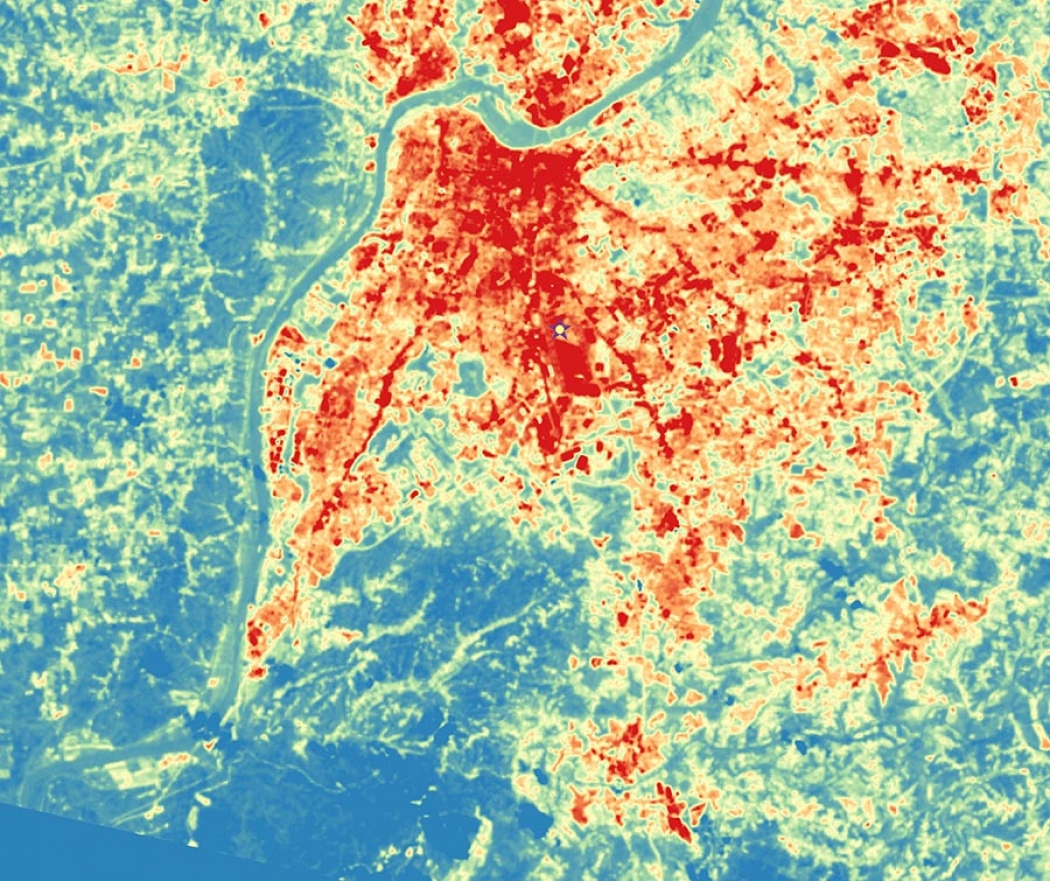
Urban heat islands are even more intense at night. Over the past 10 years, average summer overnight temperatures were more than 4°F hotter in cities than surrounding rural areas.


Urban heat measured by satellite in Louisville, Ky. Click image to enlarge. 

Several independent studies have shown that urban heat islands (in the U.S., and around the world) do not bias global warming measurements, ruling out the possibility that rising global temperatures have been caused by urbanization alone.

Research suggests that urban planning and design that incorporates more trees and parks, white roofs, and alternative materials for urban infrastructure can help reduce the effects of urban heat islands.

But rising greenhouse gas emissions are projected to drive average U.S summer temperatures even higher in the coming decades, exacerbating urban heat islands and their associated health risks. 

Research report written by Alyson Kenward, Senior Scientist and Research Director for Climate Central; Dan Yawitz, Research Analyst and Multimedia Fellow; Todd Sanford, Climate Scientist; and Regina Wang, Research Fellow.

Monday, April 11, 2016

More EU Countries Are Giving Coal the Boot

© Guerito 2005
© Guerito 2005 (Photo credit: Wikipedia)
by Taylor Hill, Take Part: http://www.takepart.com/article/2016/04/07/quarter-european-countries-ditch-coal 

Taylor Hill is an associate editor at TakePart covering environment and wildlife Bio

The final lumps of coal were burned last week at the last remaining coal-fired power plant in Belgium, signaling an end to the coal power era in yet another European country.

Just last month, Scotland’s 115-year-long dependence on the dirty, carbon emission-spewing power source came to an end as the Longannet Power Station - once the largest coal plant in Europe - was switched off on March 24.

With plants idled all over the continent, now more than a quarter of European Union nations have quit coal, with Belgium and Scotland’s shutdowns bringing them in line with coal power-free countries Cyprus, Luxembourg, Malta, Latvia, Estonia, and Lithuania. They will be joined by larger EU nations come 2025, when Portugal, Austria, Finland, and the rest of the U.K. have promised to rid their power grids of one of the dirtiest forms of energy production.

While fossil fuels such as natural gas are still part of these nations’ energy equations, clean renewable power from wind and solar farms is meeting record levels of their electricity needs.

“Belgium going coal free is yet another proof that the golden days of the coal industry are over,” Joanna Flisowska, policy coordinator at Climate Action Network Europe, said in a statement. “This is good news for the climate. To avoid the worst impacts of climate change, the EU has to ensure that carbon emissions from its coal power plants are cut down much faster than their current rate.”

Now, for the first time, the argument for cutting carbon emissions in favor of the environment - but at the expense of economic growth - isn’t holding up.


Thursday, March 24, 2016

James Hansen's Climate Bombshell: Dangerous Sea Level Rise Will Occur in Decades, Not Centuries

Taking into consideration "rapid, large, human-made climate forcing," the study predicts a much more accelerated rate of sea level rise of several meters, beyond that which humanity is capable of adapting to. (Photo: Christopher Michel/cc/flickr)
Sea-level rise (Photo: Christopher Michel/cc/flickr)
by Lauren McCauley, Common Dreams: http://www.commondreams.org/news/2016/03/22/james-hansens-climate-bombshell-dangerous-sea-level-rise-will-occur-decades-not

Dr. James Hansen, the former NASA scientist who is widely credited with being one of the first to raise concerns about human-caused global warming, is a co-author of a new report predicting that the world will undergo devastating sea level rise within mere decades - not centuries, as previously thought.

The report, published Tuesday in the open-access journal Atmospheric Chemistry and Physics, paints an even bleaker picture of the planet's future, positing that continued high fossil fuel emissions will "increase powerful storms" and drive sea-level rise of "several meters over a timescale of 50 to 150 years."

Hansen, who now serves as the director of the Climate Science Awareness and Solutions program at Columbia University Earth Institute, published the findings along with an international team of 18 researchers and academics.

As the abstract states, the predictions "differ fundamentally from existing climate change assessments." For example, the United Nation's Intergovernmental Panel on Climate Change (IPCC) in 2013 predicted three feet of sea level rise by 2100 if greenhouse gas emissions continue unabated.

A draft version of Hansen's paper released last year provoked wide debate among climate scientists. Nonetheless, Michael Mann, a renowned climate scientist with the University of Pennsylvania, who is among those questioning some of the report's "extraordinary" claims, told the New York Times, "I think we ignore James Hansen at our peril."

The peer-edited report examines growing ice melt from Antarctica and Greenland and studies how that melting has historically amplified "feedbacks that increase subsurface ocean warming and ice shelf melting." Taking into consideration "rapid, large, human-made climate forcing," the study predicts a much more accelerated rate of sea level rise of several meters, beyond that which humanity is capable of adapting to.

Or, as Hansen put it, "We’re in danger of handing young people a situation that’s out of their control." These staggering claims come as climate scientists continue to reel from the frightening speed at which the Earth is warming. On Monday, the World Meteorological Organization (WMO, issued a report warning that climate change is occurring at an "alarming rate" and that world leaders must act to curb greenhouse gases now, "before we pass the point of no return."

In a video released alongside the new report, Hansen, who left his position at NASA in 2013 so that he could fully commit himself to fighting climate change, says that the paper explores the consequences of continued greenhouse gas emissions. These include "superstorms stronger than any seen in modern times," sea level rise that will erase "all coastal cities," and, finally, "how soon we will pass points of no return."


Tuesday, October 6, 2015

Top Indicators our Climate Change is Permanent

Can Positive Shrinkage Change the World, boomer warrior
Credit: World-Map-Face-Blue-Eyes-Images
by Rolly Montpellier, BoomerWarrior: http://www.boomerwarrior.org/2015/09/top-indicators-our-climate-change-is-permanent/ 

As a Climate Reality Leader, I like to feature blog pieces from the multiple resources of the Climate Reality Project (Rolly Montpellier ~ BoomerWarrior Managing Editor).

How do we know our climate is changing permanently, rather than just going through a normal period of flux?

Let’s look at major changes scientists have seen in our climate system to help set the record straight.

Few global trends have been as controversial as climate change and the Earth’s warming. The Earth has gone through many shifts in cooling and warming driven by natural factors like the sun’s energy or variations in its orbit, but the trend scientists have seen over the past 50 years is unmistakable.

Let’s take a closer look: globally, average surface temperatures increased 1.1 - 1.6 degrees Fahrenheit (0.6 - 0.9 degrees Celsius) between 1906 and 2005. However, it’s the rate of temperature change that’s especially troubling to scientists; temperatures have risen nearly twice as fast in the last 50 years alone.

What other ways has our climate system changed in the last century? How do we really know our climate is changing permanently, rather than just going through a normal period of flux? Between opinions from climate deniers and misinformation campaigns from the fossil fuel industry, it can be a challenge to get the unobstructed facts.

So to help set the record straight, we’re going to focus on major changes scientists have seen in our climate system. Each indicator described below has been extensively studied over the past several decades, and was captured from many different data sets and technologies.

Air Temperatures over Land are Increasing

Top Indicators Our Climate Change is Permanent, boomer warrior

It’s clear that weather stations on land show average air temperatures are rising, and as a result, the frequency and severity of droughts and heat waves are increasing. Intense droughts can lead to destructive wildfires, failed crops, and low water supplies, many of which are deeply affecting southern areas of the United States and other parts of the world.

Air Temperatures over Oceans are Increasing

Roughly 70% of the world is covered by oceans, so you can understand how hotter air over them could make a vast difference in the climate system. Oceans evaporate more water as the air right near the surface gets warmer. The result? More floods, more hurricanes, and more extreme precipitation events.

Arctic Sea Ice is Decreasing

Top Indicators Our Climate Change is Permanent, boomer warrior

Satellite images from space show that the area covered by sea ice in the Arctic is shrinking, and it’s continued a downward trend for the past 30 years. The Arctic ice cap grows each winter when there’s less sunlight, and shrinks each summer when days are longer, reaching its lowest point of the year in September.

Some research suggests that the Arctic could lose almost all of its summer ice cover by 2100, but others believe that it could melt completely much sooner than that - in just a few decades.

Glaciers are Melting and Snow is Decreasing

Top Indicators Our Climate Change is Permanent, boomer warrior

The disappearance of glaciers is one of the clearest signs of climate change. People who rely on melting glacier water are facing shortages, and in many regions, the situation is only getting worse.

In a world unaffected by climate change, glacier mass stays balanced, meaning the ice that evaporates in the summer is fully replaced by snowfall in the winter. However, when more ice melts than is replaced, the glacier loses mass. And the people who depend on melting ice for water to support their farming and living needs are deeply affected.

Satellites show areas covered by snow in the Northern Hemisphere are becoming smaller. Snow is important as it helps control how much of the sun’s energy Earth absorbs. Light-colored snow and ice reflect this energy back into space, helping keep the planet cool.

However, as the snow and ice melts, it’s replaced by dark land and ocean, both of which absorb energy. The amount of snow and ice loss in the last 30 years is higher than many scientists predicted, which means the Earth is absorbing more solar energy than had been projected.

Sea Levels are Rising

Top Indicators Our Climate Change is Permanent, boomer warrior

Sea levels have been rising for the past century. And the pace is only increasing in recent years as glaciers melt faster and water temperatures increase, causing oceans to expand. You can imagine how this would affect the almost 40% of the US population that lives in a highly populated coastal area. Let’s not forget that eight of the 10 largest cities in the world are near a coast.

Consider how many millions of people are at risk as sea levels rise, storms intensify, and more extreme flooding occurs. Additionally, marine life is threatened as salt water intrudes into fresh water aquifers, many of which support human communities and natural ecosystems.

Ocean Heat Content and Sea Surface Temperature are Increasing

The ocean stores and releases heat over long periods of time. This is a natural and important part of stabilizing the climate system. Natural climate patterns (think, El Niño) occur regularly because of warmer ocean waters and influence areas like regional climates and marine life.

But it’s when short-term, natural climate patterns like El Niño occur at the same time as oceans are becoming warmer and warmer that we know that larger changes are happening. The increased heat content leads to higher sea levels, melting glaciers, and stress to marine ecosystems.

Measuring instruments also show that water temperatures at the ocean’s surface are going up. To some extent, this is a normal pattern: the ocean surface warms as it absorbs sunlight. The ocean then releases some of its heat into the atmosphere, creating wind and rain clouds.

However, as the ocean’s surface temperature continues to increase over time, more and more heat is released into the atmosphere. This additional heat can lead to stronger and more frequent storms like tropical cyclones and hurricanes.

Earth’s Lower Atmosphere Temperature in Increasing

The lowest layer of the atmosphere, called the troposphere, is the layer we’re most familiar with - it’s where we live and where our weather occurs. Satellite measurements show that this lowest layer of the atmosphere is warming as greenhouse gases build up and trap heat that radiates from the Earth’s surface.

Scientists tell us that human activity, particularly the burning of fossil fuels, caused this increase in atmospheric temperatures. In fact, carbon dioxide levels have increased about 40% since the Industrial Revolution began in 1750. And unless we put a stop to this trend as soon as possible, these levels - and temperatures - likely will increase even more.

Time to Take Action

It’s difficult to argue against what’s happening once you’ve seen these ten climate change indicators. That’s why it’s up to each and everyone one of us to do our part and help spread truthful information about climate change to our networks of friends, peers, and family.

Rolly Montpellier is the Founder and Managing Editor of BoomerWarrior.Org. He’s a Climate Reality leader, a Blogger and a Climate Activist. He’s a member of Climate Reality Canada, Citizens’ Climate Lobby (Ottawa) and 350.Org (Ottawa), the Ethical Team (as an influencer)  and Global Population Speakout.

Rolly has been published widely in both print and online publications. You can follow him on FacebookTwitter and Linkedin.

Friday, August 21, 2015

It’s Official. Climate Change Is Making California’s Drought Worse - Much Worse: A First-Of-Its-Kind Study Quantifies How Rising Temperatures Could Make the State’s Record Dry Spell Permanent

(U Hamacher/Getty Images; S Radosavljevic/Getty Images)
by Taylor Hill, Take Part: http://www.takepart.com/article/2015/08/20/drought-climate-change-california-link
Taylor Hill is an associate editor at TakePart covering environment and wildlife.

How much worse is our carbon spew making California’s record-breaking drought?

About 15 to 20% worse, according to a new study that is the first to put a number on climate change’s impact on the state’s dry spell.

“We weren’t looking at the length of the drought but the severity of it,” said A. Park Williams, a climate scientist at Columbia University’s Lamont-Doherty Earth Observatory and lead author of the study, which was published Thursday in the journal Geophysical Research Letters. “In the absence of global warming, there would still be a drought in California; it would be just be less severe.”

The findings are part of a growing body of evidence that people are playing a major role in the state’s four-year-long drought.

Noah Diffenbaugh, professor of environmental earth system science at Stanford University, said the latest study complements his ongoing research on a persistent high-pressure system called the “ridiculously resilient ridge.” The Triple-R, as it’s been dubbed, has been lingering over the Pacific Ocean and steering storms away from California’s coast. Research shows that the phenomenon is more likely to occur as temperatures increase.


“The historical warming trend we’re seeing is really doubling the probability of severe drought conditions across the state, and this new paper is a confirmation,” Diffenbaugh said.

To get a figure - instead of just an “influence” - on how much climate change is shaping the state’s drought, Williams and his colleagues broke California into a grid of 24,000 regions, or “buckets.”

They then looked at a century’s worth of historical precipitation levels - the main influencer of drought - for each bucket, along with other drought influencers such as temperature, wind speed, humidity, and net radiation.


“Through our models, we can go back and manipulate the climate scenarios, and by just teasing out the temperature increases that we’ve already seen, we were able to show that this drought is substantially worse due to global warming,” Williams said.

Diffenbaugh and other Stanford scientists are now investigating just how dry the state will become if the current rate of carbon emissions continues.

“Look at the last 120 years of data, and you’ll see that California used to have about half of its years above average temperatures and half below average, and half wet years and half dry - but over the past 20 years, that’s not the case,” Diffenbaugh said. “California’s warmed so much that more than 80% of the years now are warmer than average.”

Even if temperatures are kept from rising more than 2 degrees Celsius - the threshold for avoiding catastrophic climate change - California will likely experience longer, more severe, and more frequent droughts.

“Precipitation will vary up and down in California, but the real risk is that the temperature effect becomes so strong that it melts snowpack quicker, draws water out of soil and plants, and puts much of the state in perpetual drought conditions,” Williams said.

In other words, drought could become the new norm for the Golden (Brown) State - something Diffenbaugh says California is not prepared for. “Water storage and water rights in the state are based on the climate of 100 years ago, not for the conditions we’re going to be facing,” he said.