Showing posts with label Pollution. Show all posts

Thursday, May 18, 2017

This South Pacific Island of Rubbish Shows Why We Need to Quit Our Plastic Habit

Jennifer Lavers, University of Tasmania

A remote South Pacific island has the highest density of plastic debris reported anywhere on the planet, our new study has found.

Our study, published in the journal Proceedings of the National Academy of Sciences, estimated that more than 17 tonnes of plastic debris has washed up on Henderson Island, with more than 3,570 new pieces of litter arriving every day on one beach alone.

Our study probably actually underestimates the extent of plastic pollution on Henderson Island, as we were only able to sample pieces bigger than two millimetres down to a depth of 10 centimetres. We also could not sample along cliffs. Jennifer Lavers, Author provided

It is estimated that there are nearly 38 million pieces of plastic on the island, which is near the centre of the South Pacific Gyre ocean current.

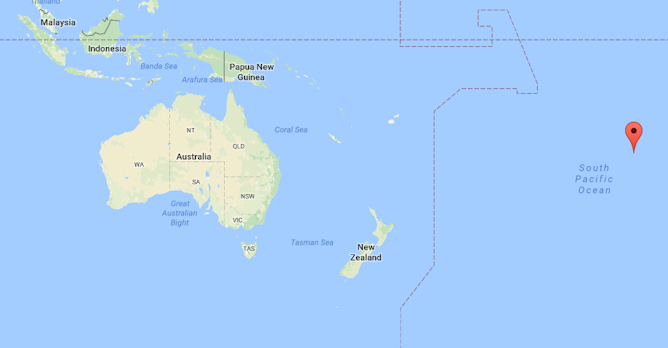
Henderson Island, marked here by the red pin, is in the UK’s Pitcairn Islands territory and is more than 5,000 kilometres from the nearest major population centre. That shows plastic pollution ends up everywhere, even in the most remote parts of the world. Google Maps

A 2014 paper published in the journal PLOS One used data from surface water all over the world. The researchers estimated that there are 5.25 trillion pieces of plastic in the top 10 centimetres of the world’s oceans.

Plastics pose a major threat to seabirds and other animals, and most don’t ever break down – they just break up. Every piece of petrochemical-derived plastic ever made still exists on the planet.

Jennifer Lavers, Research Scientist, Institute for Marine and Antarctic Studies, University of Tasmania

This article was originally published on The Conversation. Read the original article.

Tuesday, April 4, 2017

Every Single Piece of Plastic Ever Made Still Exists - Here’s the Story

by Diego Gonzaga, Contributor Content Editor for Greenpeace USA, The Huffington Post: http://www.huffingtonpost.com/entry/every-single-piece-of-plastic-ever-made-still-exists_us_58d15c2ce4b07112b647322c

From the moment we wake up in the morning and brush our teeth to the moment we watch TV at the end of the day, plastic is all around us. So much so that it can be hard to imagine leaving the supermarket without at least one item that isn’t in a plastic container.

It hasn’t always been like this. In fact, there are people alive today who were born in an almost plastic-free world. Imagine going to the beach and not finding a single piece of washed up plastic trash. What, in the course of history, caused such a change?

There are a few stories of what drove the demand for modern plastics. One version is that, in the second half of the 19th century, companies in the billiard ball industry realized they needed a substitute for ivory. By then, humans were consuming at least one million pounds of the material each year, and newspapers were reporting that elephants would soon become extinct if that pace continued.

And so the race to come up with a new material began. Over the course of several decades, chemists from Europe and the U.S. searched for solutions. After years of trial and error, they discovered plastic as we know it today, and by the beginning of the 20th century, people could buy hair combs and clothes with buttons that were not made of ivory.

Even with this scientific development, there were still no plastic bags flying around the cities, or fish being caught up in plastic rings. So, what triggered this explosion of plastic in our lives?

Two important factors pushed manufacturers to embrace this substance. First was the development of mass production assembly lines. Before that, factories required a lot of labour to manufacture even a single product, making plastic prohibitively time consuming.

The second factor was World War II. The material was used in many ways, from bazooka barrels to aircraft components, and between 1939 and 1945, the production of plastic almost quadrupled. With the end of the war, plastic companies needed to keep making a profit, so they had to switch from military vehicles to Barbie dolls. Plastic was so cheap, everyone could afford it: plastic containers, plastic furniture, plastic toys. And that’s when the material gained widespread traction.


But what was a solution before is a problem now. Because plastic lasts for so long, every single piece of plastic ever made still exists, and will continue existing for at least 500 years. To put that in context, if Leonardo da Vinci had drunk water from a plastic bottle when he was painting the Mona Lisa, that bottle would not have fully decomposed yet.

Every day, more and more plastic is produced, used and thrown away. In countries where disposable cups are made of plastic, for example, it may take only seconds for one to leave the package, be used, and end up in a trash can. So much plastic is being consumed that there is an area bigger than France of throw-away plastic swirling at all depths in the North Pacific Ocean. It has become so ubiquitous that birds are using it to build their nests.


And it’s not just the amount of plastic being produced. Everything related to plastic is damaging the planet, from the impact of extracting the fossil fuels used to produce plastic, to the health effects of the toxins it releases into the environment when it is burned, to the devastating impact on sea life.

There is something you can do about it. Reducing the amount of plastic you use might seem difficult, but it’s simpler than you think. You can make a difference by many ways, from simple actions like bringing your own bag to the grocery store, to avoiding plastic cutlery and products containing microbeads. What is important is to be conscious about what you are consuming and how it is affecting not only your life and your surroundings, but the whole planet and its many magnificent species, large and small. 

Diego Gonzaga is a content editor for Greenpeace USA.

Tuesday, October 20, 2015

Rich Nations Failing to Meet Climate Obligations at Expense of Poor: Report

Rich countries which benefited from burning fossil fuels for centuries are not doing enough to prevent irreversible climate change. (Photo: Billy Wilson/flickr/cc)
Still burning fossil fuels (Photo: Billy Wilson/flickr/cc)
by Nadia Prupis, staff writer, Common Dreams: http://www.commondreams.org/news/2015/10/19/rich-nations-failing-meet-climate-obligations-expense-poor-report

The U.S. and other wealthy nations are not pulling their weight in the climate change fight and may be setting the world on an even more devastating climate track, a new report published Monday reveals.

Globally, governments' pledges to limit greenhouse gas emissions are not adequate to stave off an average surface temperature warming of 2°C, the agreed threshold to prevent irreparable global warming and extreme weather events, according to the report (pdf), Fair Shares: A Civil Society Equity Review of Intended Nationally Determined Contributions (INDCs), crafted by 18 civil society groups.

The groups, which include Friends of the Earth International and Oxfam, analyzed the pledges put forth ahead of time in early negotiations in Bonn, Germany this week by about 150 United Nations (UN) member states taking part in this year's COP21 climate talks in Paris and determined that the "ambition of all major developed countries falls well short of their fair shares."

While there is no official method of determining a nation's climate obligations, the civil society groups weighed the pledges against individual countries' economic wealth and historical contribution to global warming.

Because the U.S. and the European Union (EU) can afford to switch from fossil fuels to renewable energy, and because they have benefited financially from burning coal, oil, and natural gas for centuries, their pledges amount to roughly a fifth of what they owe on climate action, the coalition said. Japan has pledged a tenth, according to the same metrics.

Meanwhile, emerging nations were found to "exceed or broadly meet" their obligations. Kenya, China, India, Brazil, Indonesia, and the Marshall Islands are among the developing economies which are going beyond the call of duty.

"Emission cut pledges made by rich countries so far are less than half of what we need to avoid runaway climate change," said Susann Scherbarth, climate justice and energy campaigner at Friends of the Earth Europe. "The draft Paris agreement on the negotiating table this week shows that many seem ready to accept irreversible and devastating consequences for people and the planet."

The talks in Bonn, which will continue until Friday, are the last chance for nations to finalize their climate pledges before COP21 talks commence on November 30. The civil society groups' full report will be published next month.

Brandon Wu of ActionAid added, "Across the board, rich countries are failing to bring the two most important ingredients to the negotiating table - emission cuts and money."

The coalition found more than the so-called "action gap." According to Friends of the Earth Scotland (FOES), wealthy nations may even be purposefully shirking their duties and shifting climate obligations onto their developing neighbors.

FOES head of campaigns Mary Church said, "What we are seeing as the Bonn talks open is rich countries setting the stage for a great climate getaway in which they shift the burden of responsibility for tackling the climate crisis onto the shoulders of the poor."

"If the deal that world leaders sign in Paris looks anything like the Bonn negotiating text, then world leaders will have wholly failed to respond to the urgency of climate science, let alone climate justice," Church said.

"Wealthy countries understand the need to tackle the climate crisis, but are stubbornly unwilling to respond to it in a fair and equitable way," Church continued. "As they stand, combined pledges put us on track for 3ÂșC warming which means devastating impacts for billions of the world's poorest people. Not only are developed countries delaying urgent action to curb climate emissions at home, they are also failing to provide necessary support and finance to developing countries to adapt to the impacts of climate crisis that are already being felt."

Wednesday, June 10, 2015

Shell’s Arctic Drilling is the Real Threat to the World, Not Kayaktivists: Oil Firm has Created a ‘Safety Zone’ to Keep Protesters Out of its Drilling Sites

(Photo: Backbone Campaign/flickr/cc)
 
Shell has one or two rivals for the title of Planet’s Most Irresponsible Company, but it’s definitely the most ironic.

The grand irony, of course, is that, having watched the Arctic melt as global temperatures rose, Shell was first in line to drill the newly melted waters for yet more oil which would raise the temperature some more.

But lately, the planetary-scale irony was compounded by one of a more local variety, contained in the phrase safety zone.

Here’s the backstory: In May, Shell convinced a federal judge in Alaska to enjoin Greenpeace from protesting too closely to Shell’s Arctic drilling vessels. This restricted area, or safety zone, was set at 500 yards (457 metres) while these vessels transit in Seattle’s Puget Sound.

Then, last month, 500 kayaks congregated around one of Shell’s giant Arctic drilling rigs as it sat in Puget Sound, a David-and-Goliath picture that flew across the web. And a couple of brave souls peacefully suspended themselves from another one of its drilling vessels, as others had done a month earlier.

No one was hurt. But Shell didn’t like any of this, so the company, in a not-so-subtle attempt to intimidate opposing voices, decided to send out a copy of the Greenpeace injunction to 350.org and others who oppose its Arctic drilling plans.

Of course no court as yet has drawn a safety zone around the Arctic, even though a January study published in the journal Nature made it clear that if we open up the stores of gas and oil in the far north we won’t be able to protect the climate from dramatic change. Instead, Barack Obama invited Shell to drill.

The president argued on Twitter last week that he couldn’t stop all drilling the Arctic, but that’s way too easy. True, he can’t keep the Russians and Canadians from drilling in their territory, but in the US the decision was entirely up to him. He didn’t have to give the people who chanted “drill baby drill” at the GOP convention in 2008 what they wanted.

And there is something else too. The need for coordinated international action to stop climate change is exactly we have been having United Nations summits on the topic every year since 1990 - with a very important agreement set to be signed in Paris this December. Obama could be pushing right now to get a ban on Arctic drilling locked into that agreement - but draft texts make no mention of such a sensible plan.

In the meantime, there is no safety zone for wildlife and indigenous people when something goes wrong (and something will go wrong - if a pipeline can break under the beach in benign Santa Barbara, it’s only a matter of time before the Chukchi Sea wreaks some kind of havoc on Shell’s platforms).

But even if Shell never spilled a drop, all the carbon it’s bringing up will eventually be spilled into the atmosphere - an atmosphere that’s already way past its safety zone, as CO2 emissions have spiked from 280 parts per million in the Holocene to more than 400 ppm today.

You can see the effects already, even from Seattle: Washington is suffering through what the governor called an unprecedented drought, and last summer battled to contain the biggest wildfire in its history.

Shell has a long history of this kind of irresponsibility - this is the same company who worked hand in glove with the Nigerian military dictatorship that killed Ken Saro-Wiwa and eight other leaders for daring to stand up to Shell; there are drinking water wells in the Niger Delta where chemicals like benzene can be found at 900 times their safe levels.

It is a company that announced in 2009 it would no longer invest in solar or wind power because it thought it could make more money from oil. It is, in the words of the former chief climate envoy for the UK, John Ashton, a “narcissistic, paranoid, and psychopathic” organisation.

In fact, in a world serious about protecting its people and its climate, there would be a safety zone several miles outside the edge of Earth’s atmosphere where Shell was not allowed, and a sign directing it to wreck Venus instead.

But, as usual, the rich and powerful are using the legal system to further exploit the planet. The language in the injunction is richly ironic: Shell was able to obtain “relief” because the threat it faced was “actual and imminent, not conjectural or theoretical.”

In Shell’s view, this apparently describes the peril posed by Americans in kayaks. By any honest reading, though, it’s an indictment of this multinational, one that is utterly undeterred by science in its ceaseless, unblinking quest for profit.

Bill McKibben is the Schumann Distinguished Scholar at Middlebury College and co-founder of 350.org. His most recent book is Eaarth: Making a Life on a Tough New Planet.

Annie Leonard is the executive director of Greenpeace USA, founder of the Story of Stuff Project, and has spent more than twenty years investigating and organizing on environmental health and justice issues. In addition to the original short film, Story of Stuff,  she also created The Story of Cap & TradeThe Story of Cosmetics, The Story of Bottled Water, and The Story of Electronics.

Naomi Klein is an award-winning journalist, author, and syndicated columnist. Her new book, This Changes Everything: Capitalism vs the Climate (Simon & Schuster, 2014), has just been published. Her previous books include the international best-sellers,  The Shock Doctrine: The Rise of Disaster Capitalism and No Logo: Taking Aim at the Brand Bullies.   To read all her writing visit www.naomiklein.org. Follow her on Twitter: @NaomiAKlein.

Thursday, May 21, 2015

The New Santa Barbara Oil Spill Is a Reminder of How Little We’ve Learned: The Latest Accident Highlights the Inherent Risks of Transporting Oil Through Sensitive Environments

Refugio State Beach
Goleta Beach, California, May 19 (Lucy Nicholson/Reuters)
by , Take Part: http://www.takepart.com/article/2015/05/20/oil-spill-santa-barbara-flashback

Taylor Hill is TakePart's associate environment and wildlife editor, full bio
 
For Santa Barbara residents, the recurring scene involving blackened beaches, slick-sheened waters, and muck-covered wildlife isn’t a case of dĂ©jĂ  vu - it just feels like it.

On Tuesday, a report indicated that anywhere from 21,000 gallons to 105,000 gallons of crude oil had gushed onto the beaches just northwest of the famously scenic seaside town - made infamous by a 1969 offshore oil blowout that saw around 3 million gallons of oil blanket its pristine coast - the third-largest oil spill in U.S. history.

This time, the rupture wasn’t offshore. It came from a burst 24-inch pipeline about a quarter mile inland from the coast. Crude oil trickled down a storm drain and spread along Refugio State Beach and into the ocean.

The report came in Tuesday around noon, when a beach-going citizen noticed a stench in the air. By 3pm, the Coast Guard had found and neutralized the source - an underground pipeline owned by Plains All American, an oil infrastructure giant with more than 17,000 miles of crude and natural gas lines streaming across the country.

The burst line has resulted in at least a quarter mile of oil-splattered coastline, where the high tide from Tuesday night carried globs of crude into the rocky intertidal zone of Refugio State Beach south toward El Capitan Creek.

Zack Warburg, a local photographer, got to the site around 9am on Wednesday morning. “You can see what it looks like in the photos, but what was really upsetting was the smell,” Warburg said. “It was unbearable. After an hour at the scene I left because I was getting such a bad headache.”

By mid-morning Wednesday, the wind had carried two slicks - one a four-mile-long ribbon 50 to 75 feet wide and one a triangular slick - about five miles offshore, both heading south toward Santa Barbara’s coast. "This is more than an inconvenience, this is a disaster,” Santa Barbara County Supervisor Doreen Farr told the Los Angeles Times.

A boat with the nonprofit collective Clean Seas deploys a boom, with an oil platform seen in the distance, to try to contain an oil spill on May 19, north of Goleta, California. (Photo: David McNew)
Clean Seas, the group contracted to clean up the oil spill, has three vessels on the scene skimming oil from the surface, with five other boats towing booms to trap and corral the oil from spreading further. Coast Guard vessels are assisting in the cleanup as well.

Kyle Hanson, operations manager at Clean Seas, said the offshore cleanup should take around three days but didn’t give a timeline on how long the beach cleanup would take.


“Right now, there are around seven or eight cleanup crews working on the sandy sections of the beach, and once they clean those up, they’ll focus on the high-tide portion where the cobble and boulders were left with a splattering of oil,” Hanson said.

According to state and U.S. Coast Guard officials, no wildlife impacts have been reported yet, but the California Department of Fish and Wildlife issued a fisheries closure effective one mile east and west of the site.

At a news conference on Wednesday, Plains All American district manager Darren Palmer said the ruptured line had undergone an integrity check two weeks ago but the results hadn’t come back before the breach.

Oil surrounds the feet of a local resident on the beach north of Goleta, California. (Photo: David McNew/Getty Images)
“Plains deeply regrets this release has occurred and is making every effort to limit its environmental impact," the company said in a statement. This line was part of a larger oil transport network centered in Kern County, where oil is carried from Exxon Mobil’s Las Flores Canyon facility toward Gaviota. The 11-mile pipeline was built in 1991 and can carry 150,000 gallons of crude through the line daily.
For environmental groups, the spill is an opportunity to skewer the “technological advancements” in use that oil companies claim make oil extraction and transportation techniques safe.

“We continue to be vulnerable to big risks from big oil,” said Joel Reynolds, western director and senior attorney for the National Resources Defense Council. “If we are going to allow this kind of extraction activity in sensitive areas like Santa Barbara, we can expect to see spills.”

Consumer rights group Food & Water Watch used the spill as a chance to remind everyone of the dangers of fracking.

Local residents patrol the oil-covered beach for distressed wildlife on May 19 north of Goleta, California. (Photo: David McNew/Getty Images)
“This incident is all the more reason to ban fracking both offshore and onshore to help prevent future spills and protect Santa Barbara’s beautiful beaches and coastal environment," the group said in a statement.

The modern environmental movement was born in part from the reaction to the devastating oil spill of 1969 that battered this same coastline and killed more than 3,600 seabirds along with unknown numbers of dolphins, sea lions, elephant seals, and other marine animals.

The spill was also the catalyst for a freeze on any additional offshore oil drilling in California waters - —a moratorium that’s been in place for more than 40 years.

Officials stand on the oil-covered beach north of Goleta, California, on May 19. (Photo: David McNew/Getty Images)
“When you look back, the entire structure of many of today’s environmental laws came in part because of the devastation of the Santa Barbara oil spill and Cuyahoga River fire of 1969,” Reynolds said.

The movement galvanized the creation of the Environmental Protection Agency in 1970, the passage of the Clean Water Act in 1972, and the establishment of the California Coastal Commission, considered one of the strongest coastal protection bodies in the country, in the same year.

Clean Seas, the nonprofit group in charge of this new cleanup, was created in reaction to the 1969 spill - oil companies operating in the Santa Barbara Channel formed the group to function as a first responder for oil spills. Its vessels docked in Ventura Harbor can be at any oil spill in the channel within 20 minutes.

An unidentified, oil-covered surfer walks along
Hobson Beach, Santa Barbara, California, in February
1969. (Photo: Vernon Merritt III/Life Picture Collection/
Getty Images)

It’s a sea change from the old days, when Union Oil’s Platform A erupted offshore and the early cleanup crew response was to throw straw and kitty litter on it, but it doesn’t keep the environment safe from oil’s potential impacts as long as crude continues to be pumped across the ocean and the country.

“They had a safety shutoff valve on the pipe, but it didn’t work,” Reynolds said. “And now we’re seeing oil spread across the ecologically sensitive and unique Southern California coast. Not that we haven’t seen it before, but it’s tragic every time.”

The Western States Petroleum Association said in a statement: “Once the incident is contained and thoroughly cleaned up, they will review the facts surrounding this incident and apply what they learn to prevent future accidents.”

“Safe and responsible oil and gas drilling are myths,” said Friends of the Earth campaign director Marissa Knodel. “Like the 1969 oil spill, let today’s oil disaster be the catalyst for a new movement to keep fossil fuels in the ground.”

Thursday, April 23, 2015

‘Leave it in the Ground': The Stark Message for Coal

rsz_bxy55gzq-1429613134by , Renew Economy: http://reneweconomy.com.au/2015/leave-it-in-the-ground-the-stark-message-for-coal-35510

In the same week that the Abbott government came under international pressure to lift its game on its climate policy and emissions reduction targets, a new report has warned that 90% of the nation’s coal reserves must stay in the ground - or risk blowing the world’s carbon budget.

Released on Thursday, the Climate Council Report - Unburnable Carbon: Why we need to leave fossil fuels in the ground - argues that new investment in coal, oil and gas need to be reduced to zero as soon as possible in order to keep global temperature rise below the internationally accepted 2°C warming threshold.

This is because, in order to stay within the world’s carbon budget - the well accepted, scientifically-based method to determine how much carbon humanity can “spend” - the majority of the world’s fossil fuel reserves must stay in the ground: 62% of it, for just a 50% chance of meeting the 2°C limit; and 77% of it for a 75% chance.

These figures are not new, but they bear repeating. Particularly to Australia, when you consider that for coal alone, 88% of global reserves are currently considered unburnable. As the report notes, this translates to over 90% of Australia’s coal reserves being redundant, even under the most generous carbon budget.

“When it comes to coal use, it’s reached a point where we really have to tighten our belts,” former BP Australasia president and Climate Councillor Gerry Hueston said. “New coal development in Australia doesn’t add up anymore economically, socially or environmentally.”

Of course, the Abbott government’s energy and environment policies are still nowhere near to factoring in this reality.

Mind you, they’re not the only ones with their heads down a coal mine. A report in the Guardian this week noted that the carbon locked up in coal, oil and gas reserves owned by the world’s biggest fossil fuel companies had grown by 10% in the last five years, despite the repeated warnings that most existing reserves cannot safely be burned.

And if these companies and the governments which support them are “skeptical” about the science, they’re ignoring the current economic wisdom, too.

Earlier this week, global banking group HSBC released just the latest report warning that fossil fuel assets will become “non-viable” or “unburnable” - not just because of climate action, but also due to changing economics and the impact of new technologies, such as solar and storage.

Meanwhile, in Australia huge new coal mining and export developments, like in Queensland’s Galilee Basin, are being waved through by both federal and state governments, while Canberra continues to push the line is that coal is “good for humanity.”

Of course, that is precisely the opposite message to that which scientists have been trying to get across. As the report notes: “A 2°C rise in global temperature will have serious impacts on the lives and livelihoods of many people world-wide, and could trigger major changes in the Earth System.”

Just this week, Norwegian researchers have come across some of the “largest waves ever”, generated as melting ice in polar regions results in more open water - creating a feedback loop that could doom the Arctic ice cap.

Here in Australia, NSW has this week endured nearly two days of cyclonic winds and torrential rain that has claimed three lives and left 200,000 homes without power, in the latest “once-in-a-decade” storm.

“We are already at a global temperature rise of almost 1°C and climate change is making many extreme weather events in Australia significantly worse,” said report author and Climate Council Councillor Professor Will Steffen.

“A 2°C rise in global temperature will have very serious impacts on people worldwide, and could trigger major changes … like the eventual melting of the Greenland ice sheet. “If we want to meet our international obligations to keep below the 2 degree target, not only can we not develop any new coal mines but we also have to have a planned phase-out of our existing fossil fuel extraction and usage.”

To this end, the report finds that replacing Australia’s ageing coal fleet with modern renewable energy capacity would help us meet our share of the carbon budget with little or no economic cost - in fact, probably with economic benefits.

“If we want a decent chance (75%) of meeting the 2 degree target, we will blow through the carbon budget in less than two decades at the current rate,” he said. “Energy policies that support substantial fossil fuel use, such as government investment in new coal infrastructure, are simply inconsistent with tackling climate change.”

Saturday, February 14, 2015

Deep in the Amazon, a Tiny Tribe Is Beating Big Oil

Issue73_AmazonWoman_CBennett.jpg
Nina Gualinga, activist (Photo: Caroline Bennett)
by , Yes! magazine: http://www.yesmagazine.org/issues/together-with-earth/deep-in-the-amazon-a-tiny-tribe-is-beating-big-oil 

The people of Sarayaku are a leading force in 21st century indigenous resistance, engaging the western world politically, legally, and philosophically.

Patricia Gualinga stands serenely as chaos swirls about her. I find this petite woman with striking black and red face paint at the head of the People’s Climate March in New York City on September 21, 2014.

She is adorned with earrings made of brilliant bird feathers and a thick necklace of yellow and blue beads.

She has come here from Sarayaku, a community deep in the heart of the Amazon rainforest in Ecuador.

Behind Gualinga, 400,000 people are in the streets calling for global action to stop climate change. Beside her, celebrities Leonardo DiCaprio, Sting, and Mark Ruffalo prepare to lead the historic march alongside a group of indigenous leaders. Gualinga stands beneath a sign, “Keep the Oil in the Ground.”

She has traveled across continents and cultures to deliver this message. “Our ancestors and our spiritual leaders have been talking about climate change for a long time,” she tells me in Spanish above the din, flashing a soft smile as photographers crush around the celebrities. She motions to the throngs around her. “We are actually speaking the same language right now.”

A year earlier, I traveled to her village in the Ecuadorian Amazon to research the improbable story of a rainforest community of 1,200 Kichwa people that has successfully fended off oil companies and a government intent on exploiting their land for profit. How, I wondered, has Sarayaku been winning?

This is not the story most people know from Ecuador. Headlines have focused on northern Ecuador, where Chevron is fighting a landmark $9.5 billion judgment for dumping millions of gallons of toxic wastewater into rivers and leaving unlined pits of contaminated sludge that poisoned thousands of people.

Sarayaku lies in southern Ecuador, where the government is selling drilling rights to a vast swath of indigenous lands - except for Sarayaku. The community has become a beacon of hope to other indigenous groups and to global climate change activists as it mobilizes to stop a new round of oil exploration.

What I found in Sarayaku was not just a community defending its territory. I encountered a people who believe that their lifestyle, deeply connected to nature, holds promise for humans to save themselves from global warming and extinction.

They are fighting back by advancing a counter-capitalist vision called sumak kawsay - Kichwa for “living well” - living in harmony with the natural world and insisting that nature has rights deserving of protection.

Naively romantic? Think again: In 2008, Ecuador’s constitution became the first in the world to codify the rights of nature and specifically sumak kawsay. Bolivia’s constitution has a similar provision, and rights-of-nature ordinances are now being passed in communities in the United States.

Sarayaku residents describe sumac kawsay as “choosing our responsibility to the seventh generation over quarterly earnings, regeneration over economic growth, and the pursuit of well-being and harmony over wealth and financial success.”

The people of Sarayaku are the face of 21st-century indigenous resistance. Sarayaku may be a remote, pastoral community, but it is engaging the Western world politically, legally, and philosophically.

Patricia Gualinga and other Sarayaku community members have traveled to Europe to meet with foreign leaders and warn energy company executives about their opposition to oil extraction from their lands, produced their own documentary film about their struggle, filed lawsuits, leveraged their message with international groups such as Amazon Watch and Amnesty International, marched thousands of kilometers in public protest, and testified at the United Nations.

Sarayaku’s resistance has angered the pro-development Ecuadorian government - which bizarrely hails sumak kawsay while selling hotly contested oil drilling leases - but has inspired other indigenous communities across the globe.
Sabino Gualinga, traditional healer and community elder. Photo by Caroline Bennett.

Defending life and land

I climb aboard a four-seater Cessna parked at a small airstrip in the town of Shell, a rambling settlement on the edge of the Amazon rainforest in southeastern Ecuador. The town is named for Shell Oil Company, which established operations here a half century ago.

Our plane flies low over the thick green jungle. The dense growth below is broken only by rivers the color of chocolate milk, the sinewy arteries of the rainforest.

The forest canopy parts to reveal a grass airstrip and clusters of thatched huts. This is Sarayaku. Moist jungle air envelops me as I step out of the plane. The villagers escort me and my daughter, Ariel, who has been living in Ecuador and is translating for me, past a large communal hut where a woman tends a small fire.

Gerardo Gualinga, Patricia’s brother and one of the community leaders, arrives dressed in jeans, a T-shirt, and knee-high rubber boots, the signature footwear of the rainforest. He carries a tall, carved wooden staff, a symbol of his authority.

“The community is in the middle of a three-day meeting to plan our political and development work for the next year. Come along - I think you will find it interesting,” he says, motioning for us to follow him down to the edge of the broad Bobonaza River.

We board a motorized canoe and head upstream, passing slender dugouts propelled by men pushing long poles. In 10 minutes, we clamber out on the river bank and hike up to a sandy village square.

Inside an oval building with a thatched roof, we find JosĂ© Gualinga, another of Patricia’s brothers, who was then president of Sarayaku. He is holding his ceremonial staff and wearing a black headband and a Che Guevara T-shirt.

Gualinga is leading a discussion of how the community should pressure the Ecuadorian government to comply with the judgment of the Inter-American Court on Human Rights, which ruled in 2012 that the Ecuadorian government should have obtained the consent of the native people when it permitted oil drilling on Sarayaku’s territory. Following hearings in Costa Rica, the court ordered the government to apologize and pay Sarayaku $1.25 million, plus attorney’s fees.

The court decision, declared Mario Melo, attorney for Sarayaku from the Quito-based FundaciĂłn Pachamama, is “a significant contribution to a more profound safeguard of indigenous peoples’ rights, and it is an example of dignity that will surely inspire many other nations and peoples around the world.”

At a lunch break, Marlon Santi, Sarayaku’s president until 2008, explains the history of the struggle here. In the early 2000s, “The government let oil businesses exploit and explore for oil in this territory. There was no consultation. Many communities sold out to the oil companies. Sarayaku was the only pueblo that didn’t sell the right for oil companies to explore.”

Ecuador’s government ignored the community’s refusal to sell oil-drilling rights and signed a contract in 1996 with the Argentinian oil company C.G.C. to explore for oil in Sarayaku. In 2003, C.G.C. petroleros - oil workers and private security guards - and Ecuadorian soldiers came by helicopter to lay explosives and dig test wells.

Sarayaku mobilized. “We stopped the schools and our own work and dedicated ourselves to the struggle for six months,” says Santi. As the oil workers cleared a large area of forest - which was community farmland - the citizens of Sarayaku retreated deep into the jungle, where they established emergency camps and plotted their resistance.

“In the six months of struggle, there was torture, rape, and strong suffering of our people, especially our mothers and children,” Santi recounts. “We returned with psychological illness. All the military who came …” He pauses to compose himself. “This was a very, very bad time.”

In their jungle camps, the Sarayaku leaders hatched a plan. The women of the community prepared a strong batch of chicha, the traditional Ecuadorian homebrew made from fermented cassava. One night, a group of them traveled stealthily through the jungle, shadowed by men of the village. The women emerged at the main encampment of the petroleros. They offered their chicha and watched as the oil workers happily partied.

As their drinking binge ended, the petroleros fell asleep. When they awoke, what they saw sobered them: They were staring into the muzzles of their own automatic weapons. Wielding the guns were the women and men of Sarayaku.

The Sarayaku residents ordered the petroleros off their ancestral land. The terrified workers called in helicopters and fled, abandoning their weapons. The oil workers never returned. An Ecuadorian general came later and negotiated with community leaders - five of whom had been arrested and beaten - for the return of the weapons.

I ask Santi why Sarayaku has resisted. His tan, weathered face breaks into a gentle smile even as he recounts a difficult story. “Our fathers told us that for future generations not to suffer, we needed to struggle for our territory and our liberty. So we wouldn’t be slaves of the new kind of colonization.

“The waterfall, the insects, the animals, the jungle gives us life,” he tells me. “Because man and the jungle have a relationship. For the Western capitalist world, the jungle is simply for exploiting resources and ending all this. The indigenous pueblos without jungle - we can’t live.”

Sarayaku now wants to help indigenous people around the world resist and defend their way of life. “Our message that we are also taking to Asia, Africa, Brazil, and other countries that are discussing climate change, we propose an alternative development - the development of life. This is our economy for living - sumak kawsay - not just for us but for the Western world. They don’t have to be afraid of global warming if they support the life of the jungle.

“It’s not a big thing,” he says understatedly. “It’s just to continue living.”
“Indigenous lands free of oil: The cry of the living jungle,” a banner hanging on the side of a building in Sarayaku. Photo by Caroline Bennett.

Indigenous climate change warriors

The Sarayaku story is just the latest in a long-running battle over Ecuador’s natural resources. Oil extraction began in northern Ecuador in 1964, when the American oil giant Texaco set up drilling operations in indigenous lands (Chevron later purchased Texaco).

When the oil company exited in 1992, it “left behind the worst oil-related environmental disaster on the planet,” according to Amazon Watch, a nonprofit organization that defends indigenous rights. The devastated and poisoned region is known as the “rainforest Chernobyl.”

Despite pursuing Chevron for damages, the Ecuadorian government of President Rafael Correa has embarked on an aggressive new round of oil development in southern Ecuador, opening thousands of acres to exploration.

The government has cracked down on resisters, recently ordering the closure of the Quito headquarters of CONAIE, Ecuador’s national indigenous organization, attempting to stop Ecuadorian activists opposed to oil drilling from attending a U.N. climate summit in Peru, and closing FundaciĂłn Pachamama, an NGO supporting indigenous groups.

Most of Sarayaku’s land has been excluded in the new round of oil drilling, though nearby communities, including those of the neighboring SĂĄpara people, are threatened. Sarayaku is joining the protests of its neighbors.

JosĂ© Gualinga says these struggles have bigger implications. “We are doing this to stop carbon emissions and global warming. This struggle of indigenous pueblos is a doorway to saving Pachamama [Mother Earth].”

Women have been at the center of the indigenous resistance. Patricia Gualinga tells me, “The women have been very steadfast and strong in saying we are not negotiating about this. We are the ones who have mobilized for life.”

She recounts how, in 2013, 100 women from seven different indigenous groups marched 250 kilometers from their jungle communities to Quito, where they addressed the National Assembly. In the 1990s, Patricia’s mother embarked on a similar march with thousands of other indigenous women.

Sarayaku community members travel widely around Ecuador and beyond, but most return to their pastoral village. “We want to continue living a good life within the forest,” Patricia tells me. “We want to be respected, and we want to be a model that could be replicated.”
Patricia Gualinga, a community leader who has traveled the world speaking out in defense of indigenous rights, at her home in Sarayaku, Ecuador. Photo by Caroline Bennett.

The living jungle

I follow Sabino Gualinga, a 70-year-old shaman, as he walks lightly through the dense tangle of growth. He deftly flicks his machete to make a path through the jungle for me and Ariel. He stops and points up toward a tree.

“The bark of that tree helps cure grippe [flu]. This one,” he says, pointing to a weathered, gray tree trunk, “helps to break a fever. That one,” he motions to a fern-like plant, “helps with psychological problems.”

That night, Sabino’s sons, Gerardo and JosĂ©, join us in front of a flickering fire to talk about Sarayaku’s journey. They are unwinding after a long day of meetings. JosĂ© wears a white soccer jersey and his long black hair hangs loosely at his shoulders.

José, president of Sarayaku from 2011 to 2014, led his community to take its fight to the Inter-American Court on Human Rights. Part of the court judgment required Ecuadorian government leaders to apologize to Sarayaku. I doubted this would occur, but José was insistent that it would.

In October 2014, Ecuador’s Minister of Justice, Ledy Zuniga, stood in Sarayaku’s sandy community square and delivered an extraordinary message: “We offer a public apology for the violation of indigenous property, cultural identity, the right to consultation, having put at serious risk their lives and personal integrity, and for the violation of the right to judicial guarantee and judicial protections,” she declared.

The court decision and official apology appear to have given Sarayaku an extra measure of protection from new oil exploration. The government must now secure at least the appearance of consent, contested though it may be, lest they get dragged back into court.

“We’ve shown that laws can change,” reflects Gerardo. “We’ve won not only for Sarayaku, we’ve won for South America.”

A key element in Sarayaku’s success is telling its story everywhere it can. Sarayaku resident Eriberto Gualinga trained in videography and made a film about his community, Children of the Jaguar, which won best documentary at the 2012 National Geographic All Roads Film Festival.

Sarayaku has also embraced social media. Community members showed me to a thatched hut. Inside, young people were clustered around several computers updating Facebook pages and websites via a satellite Internet connection.

Now, says JosĂ©, “When the state says, ‘Sarayaku, we are going to destroy you,’ we have international witnesses. We can tell people the truth.”

JosĂ© draws a distinction between Sarayaku’s struggles and those led by leaders such as Nelson Mandela and Che Guevara. “They wanted their freedom. We don’t need to win our freedom. Here in Sarayaku, we are free. But we take from the experience of these leaders. It strengthens us.”

A steady rain falls on the thatched roof overhead. The fat raindrops make a hard thwack on the broad leaves of the trees. A guitarist strums softly in another hut. Chickens and children run free.

“We are millionaires,” says Gerardo, motioning to the jungle that embraces us. “Everything we need we have here.” JosĂ© peers into the fire. “We are a small pueblo, but we are a symbol of life. Everyone must come together to support the life of human beings and Earth.”

David Goodman wrote this article for Together, With Earth, the Spring 2015 issue of YES! Magazine. David is a journalist, a contributing writer for Mother Jones, and author of 10 books. He and his sister Amy Goodman, host of Democracy Now!, have co-authored three New York Times bestsellers; their fourth book is due out next year. He hosts “The Vermont Conversation,” a public affairs radio show.

Sunday, February 1, 2015

These Disturbing Photos Prove That Pollution Is Out Of Control In China

by Mike Cahill, Viral Nova: http://www.viralnova.com/chinese-pollution/

Over the last 30 years, China's economy has been growing at a breakneck pace. While this rapid growth has benefited the population, the environmental impact of that growth is also unreal. China is currently the world's biggest polluter and largest producer of carbon emissions. It's a fact that can be seen, felt, and even tasted.

Garbage-clogged waterway

Millions of dead fish

I'm not sure that water is safe to drink

Dumping garbage straight into the river

Surrounded in pollution

Running through the garbage

Sitting among piles of industrial garbage

So sad

More dead fish

You can barely see the sun through the haze in this picture

I'm not sure I even want to know what happened here

How did it get this bad?

Straight from the factory to the oceans

Intense smog

Devastating the countryside

Not a pleasant sight to have outside your home

What are they doing here?

So tragic

More industrial waste dumping

Careful not to breathe the air

This looks like the apocalypse

That's no wildfire, it's just smog

This might be beautiful if it wasn't so toxic

(via Reddit)

I dread to think what these parts of China will look like in another 30 years if something isn't done to clean up this damage.

Sunday, December 28, 2014

Fukushima and the Institutional Invisibility of Nuclear Disaster


Black smoke at Fukushima Daichi, 24th March 2011. Photo: deedavee easyflow via Flickr.
Fukushima Daichi, 24/3/2011 (deedavee easyflow, Flickr)
The nuclear industry and its supporters have contrived a variety of narratives to justify and explain away nuclear catastrophes, writes John Downer. 

None of them actually hold water, yet they serve their purpose - to command political and media heights, and reassure public sentiment on 'safety'. 

But if it's so safe, why the low limits on nuclear liabilities?
In a truly competitive marketplace, unfettered by subsidies, no-one would have built a nuclear reactor in the past, no-one would build one today, and anyone who owns a reactor would exit the nuclear business as quickly as possible.
Speaking at a press conference soon after the accident began, the UK government's former chief science advisor, Sir David King, reassured journalists that the natural disaster that precipitated the failure had been "an extremely unlikely event".

In doing so, he exemplified the many early accounts of Fukushima that emphasised the improbable nature of the earthquake and tsunami that precipitated it.

A range of professional bodies made analogous claims around this time, with journalists following their lead. This lamentation, by a consultant writing in the New American, is illustrative of the general tone:

" ... the Fukushima 'disaster' will become the rallying cry against nuclear power. Few will remember that the plant stayed generally intact despite being hit by an earthquake with more than six times the energy the plant was designed to withstand, plus a tsunami estimated at 49 feet that swept away backup generators 33 feet above sea level."

The explicit or implicit argument in all such accounts is that the Fukushima's proximate causes are so rare as to be almost irrelevant to nuclear plants in the future.

Nuclear power is safe, they suggest, except against the specific kind of natural disaster that struck Japan, which is both a specifically Japanese problem, and one that is unlikely to re-occur, anywhere, in any realistic timeframe

An appealing but tenuous logic

The logic of this is tenuous on various levels. The 'improbability' of the natural disaster is disputable, for one, as there were good reasons to believe that neither the earthquake nor the tsunami should have been surprising. The area was well-known to be seismically active after all, and the quake, when it came, was only the fourth largest of the last century.

The Japanese nuclear industry had even confronted its seismic under-preparedness four years earlier, on 16 July 2007, when an earthquake of unanticipated magnitude damaged the Kashiwazaki-Kariwa nuclear plant.

This had led several analysts to highlight Fukushima's vulnerability to earthquakes, but officials had said much the same then as they now said in relation to Fukushima. The tsunami was not without precedent either.

Geologists had long known that a similar event had occurred in the same area in July 869. This was a long time ago, certainly, but the data indicated a thousand-year return cycle.

Several reports, meanwhile, have suggested that the earthquake alone might have precipitated the meltdown, even without the tsunami - a view supported by a range of evidence, from worker testimony, to radiation alarms that sounded before the tsunami.

Haruki Madarame, the head of Japan's Nuclear Safety Commission, has criticised Fukushima's operator, TEPCO, for denying that it could have anticipated the flood.

The claim that Japan is 'uniquely vulnerable' to such hazards is similarly disputable. In July 2011, for instance, the Wall Street Journal reported on private NRC emails showing that the industry and its regulators had evidence that many US reactors were at risk from earthquakes that had not been anticipated in their design.

It noted that the regulator had taken very little or no action to accommodate this new understanding. As if to illustrate their concern, on 23 August 2011, less than six months after Fukushima, North Anna nuclear plant in Mineral, Virginia, was rocked by an earthquake that exceeded its design-basis predictions.

Every accident is 'unique' - just like the next one

There is, moreover, a larger and more fundamental reason to doubt the 'unique events or vulnerabilities' narrative, which lies in recognising its implicit assertion that nuclear plants are safe against everything except the events that struck Japan.

It is important to understand that those who assert that nuclear power is safe because the 2011 earthquake and tsunami will not re-occur are, essentially, saying that although the industry failed to anticipate those events, it has anticipated all the others.

Yet even a moment's reflection reveals that this is highly unlikely. It supposes that experts can be sure they have comprehensively predicted all the challenges that nuclear plants will face in its lifetime (or, in engineering parlance: that the 'design basis' of every nuclear plant is correct) - even though a significant number of technological disasters, including Fukushima, have resulted, at least in part, from conditions that engineers failed to even consider.

As Sagan points out: "things that have never happened before, happen all the time". The terrorist attacks of 9/11 are perhaps the most iconic illustration of this dilemma but there are many others.

Perrow (2007) painstakingly explores a landscape of potential disaster scenarios that authorities do not formally recognise, but it is highly unlikely that he has considered them all.

More are hypothesised all the time. For instance, researchers have recently speculated about the effects of massive solar storms, which, in pre-nuclear times, have caused electrical systems over North America and Europe to fail for weeks at a time.

Human failings that are unrepresentative and / or correctable

A second rationale that accounts of Fukushima invoke to establish that accidents will not re-occur focuses on the people who operated or regulated the plant, and the institutional culture in which they worked. Observers who opt to view the accident through this lens invariably construe it as the result of human failings - either error, malfeasance or both.

The majority of such narratives relate the failings they identify directly to Fukushima's specific regulatory or operational context, thereby portraying it as a 'Japanese' rather than a 'nuclear' accident.

Many, for instance, stress distinctions between US and Japanese regulators; often pointing out that the Japanese nuclear regulator (NISA) was subordinate to the Ministry of Trade and Industry, and arguing that this created a conflict of interest between NISA's responsibilities for safety and the Ministry's responsibility to promote nuclear energy.

They point, for instance, to the fact that NISA had recently been criticised by the International Atomic Energy Agency (IAEA) for a lack of independence, in a report occasioned by earthquake damage at another plant. Or to evidence that NISA declined to implement new IAEA standards out of fear that they would undermine public trust in the nuclear industry.

Other accounts point to TEPCO, the operator of the plant, and find it to be distinctively "negligent". A common assertion in vein, for instance, is that it concealed a series of regulatory breaches over the years, including data about cracks in critical circulation pipes that were implicated in the catastrophe.

There are two subtexts to these accounts. Firstly, that such an accident will not happen here (wherever 'here' may be) because 'our' regulators and operators 'follow the rules'. And secondly, that these failings can be amended so that similar accidents will not re-occur, even in Japan.

Where accounts of the human failings around Fukushima do portray those failings as being characteristic of the industry beyond Japan, the majority still construe those failings as eradicable.

In March 2012, for instance, the Carnegie Endowment for International Peace issued a report that highlighted a series of organisational fallings associated with Fukushima, not all of which they considered to be meaningfully Japanese.

Nevertheless, the report - entitled 'Why Fukushima was preventable' - argued that such failings could be resolved. "In the final analysis", it concluded, "the Fukushima accident does not reveal a previously unknown fatal flaw associated with nuclear power."

The same message echoes in the many post-Fukushima actions and pronouncements of nuclear authorities around the world promising managerial reviews and reforms, such as the IAEA's hastily announced 'five-point plan' to strengthen reactor oversight.

Myths of exceptionality

As with the previous narratives about exogenous hazards, however, the logic of these 'human failure' arguments is also tenuous. Despite the editorial consternation that revelations about Japanese malfeasance and mistakes have inspired, for instance, there are good reasons to believe that neither were exceptional.

It would be difficult to deny that Japan had a first-class reputation for managing complex engineering infrastructures, for instance. As the title of one op-ed in the Washington Post puts it: "If the competent and technologically brilliant Japanese can't build a completely safe reactor, who can?"

Reports of Japanese management failings must be considered in relation to the fact that reports of regulatory shortcomings, operator error, and corporate malfeasance abound in every state with nuclear power and a free press.

There also exists a long tradition of accident investigations finding variations in national safety practices that are later rejected on further scrutiny.

When Western experts blamed Chernobyl on the practices of Soviet nuclear industry, for example, they unconsciously echoed Soviet narratives highlighting the inferiority of Western safety cultures to argue that an accident like Three Mile Island could never happen in the USSR.

Arguments suggesting that 'human' problems are potentially solvable are similarly difficult to sustain, for there are compelling reasons to believe that operational errors are an inherent property of all complex socio-technical systems.

Close accounts of even routine technological work, for instance, routinely find it to be necessarily and unavoidably 'messier' in practice than it appears on paper.

Thus both human error and non-compliance are ambiguous concepts. As Wynne (1988: 154) observes: "... the illegitimate extension of technological rules and practices into the unsafe or irresponsible is never clearly definable, though there is ex-post pressure to do so." The culturally satisfying nature of 'malfeasance explanations' should, by itself, be cause for circumspection.

These studies undermine the notion of 'perfect rule compliance' by showing that even the most expansive stipulations sometimes require interpretation and do not relieve workers of having to make decisions in uncertain conditions.

In this context we should further recognise that accounts that show Fukushima, specifically, was preventable are not evidence that nuclear accidents, in general, are preventable.

To argue from analogy: it is true to say that any specific crime might have been avoided (otherwise it wouldn't be a crime), but we would never deduce from this that crime, the phenomenon, is eradicable. Human failure will always be present in the nuclear sphere at some level, as it is in all complex socio-technical systems.

And, relative to the reliability demanded of nuclear plants, it is safe to assume that this level will always be too high or, at least, that our certainty regarding it will be too low. While human failures and malfeasance are undoubtedly worth exploring, understanding and combating, therefore, we should avoid the conclusion that they can be 'solved'.

Plant design is unrepresentative and/or correctable

Parallel to narratives about Fukushima's circumstances and operation, outlined above, are narratives that emphasise the plant itself.

These limit the relevance of accident to the wider nuclear industry by arguing that the design of its reactor (a GE Mark-1) was unrepresentative of most other reactors, while simultaneously promising that any reactors that were similar enough to be dangerous could be rendered safe by 'correcting' their design.

Accounts in this vein frequently highlight the plant's age, pointing out that reactor designs have changed over time, presumably becoming safer. A UK civil servant exemplified this narrative, and the strategic decision to foreground it, in an internal email (later printed in the Guardian [2011]), in which he asserted that

"We [The Department of Business, Innovation and Skills] need to … show that events in Japan, whilst looking dramatic, are all part of the safety processes of this 1960's reactor."

Stressing the age of the reactor in this way became a mainstay of Fukushima discourse in the disaster's immediate aftermath. Guardian columnist George Monbiot (2011b), for instance, described Fukushima as "a crappy old plant with inadequate safety features".

He concluded that its failure should not speak to the integrity of later designs, like that of the neighboring plant, Fukushima 'Daini', which did not fail in the tsunami. "Using a plant built 40 years ago to argue against 21st-century power stations", he wrote, "is like using the Hindenburg disaster to contend that modern air travel is unsafe."

Other accounts highlighted the reactor's design but focused on more generalisable failings, such as the "insufficient defense-in-depth provisions for tsunami hazards" (IAEA 2011a: 13), which could not be construed as indigenous only to the Mark-1 reactors or their generation.

The implication - we can and will fix all these problems

These failings could be corrected, however, or such was the implication. The American Nuclear Society set the tone, soon after the accident, when it reassured the world that: "the nuclear power industry will learn from this event, and redesign our facilities as needed to make them safer in the future."

Almost every official body with responsibility for nuclear power followed in their wake. The IAEA, for instance, orchestrated a series of rolling investigations, which eventually culminated in the announcement of its 'Action Plan on Nuclear Safety' and a succession of subsequent meetings where representatives of different technical groups could pool their analyses and make technical recommendations.

The groups invariably conclude that "many lessons remain to be learned" and recommend further study and future meetings. Again, however, there is ample cause for scepticism.

Firstly, there are many reasons to doubt that Fukushima's specific design or generation made it exceptionally vulnerable. As noted above, for instance, many of the specific design failings identified after the disaster - such as the inadequate water protection around reserve power supplies - were broadly applicable across reactor designs.

And even if the reactor design or its generation were exceptional in some ways, that exceptionalism is decidedly limited. There are currently 32 Mark-1 reactors in operation around the world, and many others of a similar age and generation, especially in the US, where every reactor currently in operation was commissioned before the Three Mile Island accident in 1979.

Secondly, there is little reason to believe that most existing plants could be retrofitted to meet all Fukushima's lessons. Significantly raising the seismic resilience of a nuclear plant, for instance, implies such extensive design changes that it might be more practical to decommission the entire structure and rebuild from scratch.

This perhaps explains why progress has been halting on the technical recommendations. It might be true that different, or more modern reactors are safer, therefore, but these are not the reactors we have.

In March 2012, the NRC did announce some new standards pertaining to power outages and fuel pools - issuing three 'immediately effective' orders requiring operators to implement some of the more urgent recommendations. The required modifications were relatively modest, however, and 'immediately' in this instance meant 'by December 31st 2016'.

Meanwhile, the approvals for four new reactors the NRC granted around this time contained no binding commitment to implement the wider lessons it derived from Fukushima. In each case, the increasingly marginalised NRC chairman, Gregory Jaczko, cast a lone dissenting vote. He was also the only committee member to object to the 2016 timeline.

Complex systems' ability to keep on surprising

Finally, and most fundamentally, there are many a priori reasons to doubt that any reactor design could be as safe as risk analyses suggest. Observers of complex systems have outlined strong arguments for why critical technologies are inevitably prone to some degree of failure, whatever their design.

The most prominent such argument is Perrow's Normal Accident Theory (NAT), with its simple but profound probabilistic insight that accidents caused by very improbable confluences of events (that no risk calculation could ever anticipate) are 'normal' in systems where there are many opportunities for them to occur.

From this perspective, the 'we-found-the-flaw-and-fixed-it' argument is implausible because it offers no way of knowing how many 'fateful coincidences' the future might hold.

'Lesson 1' of the IAEA's preliminary report on Fukushima is that the " ... design of nuclear plants should include sufficient protection against infrequent and complex combinations of external events."

NAT explains why an irreducible number of these 'complex combinations' must be forever beyond the reach of formal analysis and managerial control.

A different way of demonstrating much the same conclusion is to point to the fundamental epistemological ambiguity of technological knowledge, and to how the significance of this ambiguity is magnified in complex, safety-critical systems due to the very high levels of certainty these systems require.

Judgements become more significant in this context because they have to be absolutely correct. There is no room for error bars in such calculations. It makes little sense to say that we are 99% certain a reactor will not explode, but only 50% sure that this number is correct.

Perfect safety can never be guaranteed

Viewed from this perspective, it becomes apparent that complex systems are likely to be prone to failures arising from erroneous beliefs that are impossible to predict in advance, which I have elsewhere called 'Epistemic Accidents'.

This is essentially to say that the 'we-found-the-flaw-and-fixed-it' argument cannot guarantee perfect safety because it offers no way of knowing how many new 'lessons' the future might hold.

Just as it is impossible for engineers and regulators to know for certain that they have anticipated every external event a nuclear plant might face, so it is impossible for them know that their understanding of the system itself is completely accurate.

Increased safety margins, redundancy, and defense-in-depth undoubtedly might improve reactor safety, but no amount of engineering wizardry can offer perfect safety, or even safety that is 'knowably' of the level that nuclear plants require. As Gusterson (2011), puts it: " ... the perfectly safe reactor is always just around the corner."

Nuclear authorities sometimes concede this. After the IAEA ’s 2012 recommendations to pool insights from the disaster, for instance, the meeting’s chairman, Richard Meserve, summarised: "In the nuclear business you can never say, 'the task is done'."

Instead they promise improvement. "The Three Mile Island and Chernobyl accidents brought about an overall strengthening of the safety system", Meserve continued. "It is already apparent that the Fukushima accident will have a similar effect."

The real question, however, is when will the safety be strong enough? As it wasn’t after Three Mile Island or Chernobyl, why should Fukushima be any different?

The reliability myth

This is all to say, in essence, that it is misleading to assert that an accident of Fukushima's scale will not re-occur. For there are credible reasons to believe that the reliability required of reactors is not calculable, and there are credible reasons to believe that the actual reliability of reactors is much lower than is officially calculated.

These limitations are clearly evinced by the actual historical failure rate of nuclear reactors. Even the most rudimentary calculations show that civil nuclear accidents have occurred far more frequently than official reliability assessments have predicted.

The exact numbers vary, depending on how one classifies 'an accident' (whether Fukushima counts as one meltdown or three, for example), but Ramana (2011) puts the historical rate of serious meltdowns at 1 in every 3,000 reactor years, while Taebi et al. (2012: 203fn) put it at somewhere between 1 in every 1,300 to 3,600 reactor years. Either way, the implied reliability is orders of magnitude lower than assessments claim.

In a recent declaration to a UK regulator, for instance, Areva, a prominent French nuclear manufacturer, invoked probabilistic calculations to assert that the likelihood of a "core damage incident" in its new 'EPR' reactor were of the order of one incident, per reactor, every 1.6 million years (Ramana 2011).

Two: the accident was tolerable

The second basic narrative through which accounts of Fukushima have kept the accident from undermining the wider nuclear industry rests on the claim that its effects were tolerable - that even though the costs of nuclear accidents might look high, when amortised over time they are acceptable relative to the alternatives.

The 'accidents are tolerable' argument is invariably framed in relation to the health effects of nuclear accidents. "As far as we know, not one person has died from radiation", Sir David King told a press conference in relation to Fukushima, neatly expressing a sentiment that would be echoed in editorials around the world in the aftermath of the accident.

"Atomic energy has just been subjected to one of the harshest of possible tests, and the impact on people and the planet has been small", concluded Monbiot in one characteristic column.

"History suggests that nuclear power rarely kills and causes little illness", the Washington Post reassured its readers (Brown 2011). See also eg McCulloch (2011); Harvey (2011). "Fukushima's Refugees Are Victims Of Irrational Fear, Not Radiation", declared the title of an article in Forbes (Conca 2012).

In its more sophisticated forms, this argument draws on comparisons with other energy alternatives. A 2004 study by the American Lung Association argues that coal-fired power plants shorten the lives of 24,000 people every year.

Chernobyl, widely considered to be the most poisonous nuclear disaster to date, is routinely thought to be responsible for around 4,000 past or future deaths.

Even if the effects of Fukushima are comparable (which the majority of experts insist they are not), then by these statistics the human costs of nuclear energy seem almost negligible, even when accounting for its periodic failures.

Such numbers are highly contestable, however. Partly because there are many more coal than nuclear plants (a fairer comparison might consider deaths per kilowatt-hour). But mostly because calculations of the health effects of nuclear accidents are fundamentally ambiguous.

Chronic radiological harm can manifest in a wide range of maladies, none of which are clearly distinguishable as being radiologically induced - they have to be distinguished statistically - and all of which have a long latency , sometimes of decades or even generations.

How many died? It all depends ...

So it is that mortality estimates about nuclear accidents inevitably depend on an array of complex assumptions and judgments that allow for radically divergent - but equally 'scientific' - interpretations of the same data. Some claims are more compelling than others, of course, but 'truth' in this realm does not 'shine by its own lights' as we invariably suppose it ought.

Take, for example, the various studies of Chernobyl's mortality, from which estimates of Fukushima's are derived. The models underlying these studies are themselves derived from data from Hiroshima and Nagasaki survivors, the accuracy and relevance of which have been widely criticised, and they require the modeller to make a range of choices with no obviously correct answer.

Modellers must select between competing theories of how radiation affects the human body, for instance; between widely varying judgments about the amount of radioactive material the accident released; and much more. Such choices are closely interlinked and mutually dependent.

Estimates of the composition and quantities of the isotopes released in the accident, for example, will affect models of their distribution, which, in conjunction with theories of how radiation affects the human body, will affect conclusions about the specific populations at risk.

This, in turn, will affect whether a broad spike in mortality should be interpreted as evidence of radiological harm or as evidence that many seemingly radiation - related deaths are actually symptomatic of something else. And so on ad infinitum: a dynamic tapestry of theory and justification, where subtle judgements reverberate throughout the system.

The net result is that quiet judgements concerning the underlying assumptions of an assessment - usually made in the very earliest stages of a study and all but invisible to most observers - have dramatic affects on its findings. The effects of this are visible in the widely divergent assertions made about Chernobyl's death toll.

The 'orthodox' mortality figure cited above - no more than 4,000 deaths - comes from the 2005 IAEA-led 'Chernobyl Forum ' report. Or rather, from the heavily bowdlerised press release from the IAEA that accompanied its executive summary. The actual health section of the report alludes to much higher numbers.

Yet the '4,000 deaths' number is endorsed and cited by most international nuclear authorities, although it stands in stark contrast to the findings of similar investigations.

Two reports published the following year, for example, offer much higher figures: one estimating 30,000 to 60,000 cancer deaths (Fairlie & Sumner 2006); the other 200,000 or more (Greenpeace 2006: 10).

In 2009, meanwhile, the New York Academy of Sciences published an extremely substantive Russian report by Yablokov that raised the toll even further, concluding that in the years up to 2004, Chernobyl caused around 985,000 premature cancer deaths worldwide.

Between these two figures - 4,000 and 985,000 - lie a host of other expert estimations of Chernobyl's mortality, many of them seemingly rigorous and authoritative. The Greenpeace report tabulates some of the varying estimates and correlates them to differing methodologies.

Science? Or propaganda?

Different sides in this contest of numbers routinely assume their rivals are actively attempting to mislead - a wide range of critics argue that most official accounts are authored by industry apologists who 'launder' nuclear catastrophes by dicing evidence of their human fallout into an anodyne melée of claims and counter claims.

When John Gofman, a former University of California Berkeley Professor of Medical Physics, wrote that the Department of Energy was "conducting a Josef Goebels propaganda war" by advocating a conservative model of radiation damage, for instance, his charge more remarkable for its candor than its substance.

And there is certainly some evidence for this. There can be little doubt that in the past the US government has intentionally clouded the science of radiation hazards to assuage public concerns. The 1995 US Advisory Committee on Human Radiation Experiments, for instance, concluded that Cold War radiation research was heavily sanitised for political ends.

A former AEC (NRC) commissioner testified in the early 1990s that: "One result of the regulators' professional identification with the owners and operators of the plants in the battles over nuclear energy was a tendency to try to control information to disadvantage the anti-nuclear side."

It is perhaps more useful, however, to say they are each discriminating about the realities to which they adhere.

In this realm there are no entirely objective facts, and with so many judgements it is easy to imagine how even small, almost invisible biases, might shape the findings of seemingly objective hazard calculations.

Indeed, many of the judgements that separate divergent nuclear hazard calculations are inherently political, with the result that there can be no such thing as an entirely neutral account of nuclear harm.

Researchers must decide whether a 'stillbirth' counts as a 'fatality', for instance. They must decide whether an assessment should emphasise deaths exclusively, or if it should encompass all the injuries, illnesses, deformities and dis abilities that have been linked to radiation. They must decide whether a life 'shortened' constitutes a life 'lost'.

There are no correct answers to such questions. More data will not resolve them. Researchers simply have to make choices. The net effect is that the hazards of any nuclear disaster can only be glimpsed obliquely through a distorted lens.

So much ambiguity and judgement is buried in even the most rigorous calculations of Fukushima's health impacts that no study can be definitive. All that remains are impressions and, for the critical observer, a vertiginous sense of possibility.

Estimating the costs - how many $100s of billions?

The only thing to be said for sure is that declarative assurances of Fukushima's low death toll are misleading in their surety. Given the intense fact-figure crossfire around radiological mortality, it is unhelpful to view Fukushima purely through the lens of health.

In fact, the emphasis on mortality might itself be considered a way of minimising Fukushima, considering that there are other - far less ambiguous - lenses through which to view the disaster's consequences.

Fukushima's health effects are contested enough that they can be interpreted in ways that make the accident look tolerable, but it is much more challenging to make a case that it was tolerable in other terms.

Take, for example, the disaster's economic impact. The intense focus on the health and safety effects of Fukushima has all but eclipsed its financial consequences, yet the latter are arguably more significant and are certainly less ambiguous.

Nuclear accidents incur a vast spectrum of costs. There are direct costs relating to the need to seal off the reactor; study, monitor and mitigate its environmental fallout; resettle, compensate and treat the people in danger; and so forth.

Over a quarter of a century after Chernobyl, the accident still haunts Western Europe, where government scientists in several countries continue to monitor certain meats, and keep some from entering the food chain.

Then there is an array of indirect costs that arise from externalities, such as the loss of assets like farmland and industrial facilities; the loss of energy from the plant and those around it; the impact of the accident on tourism; and so forth. The exact economic impact of a nuclear accident is almost as difficult to estimate as its mortality, and projections differ for the same fundamental reasons.

The evacuation zone around Fukushima - an area of around 966 sq km, much of which will be uninhabitable for generations - covers 3% of Japan, a densely populated and mountainous country where only 20% of the land is habitable in the first place.

They do not differ to the same degree, however, and in contrast to Fukushima's mortality there is little contention that its financial costs will be enormous.

By November of 2013, the Japanese government had already allocated over 8 trillion yen (roughly $80 billion or £47 billion) to Fukushima's clean-up alone - a figure that excluded the cost of decommissioning the six reactors, a process expected to take decades and cost tens of billions of dollars.

Independent experts have estimated the clean-up cost to be in the region of $500 billion (Gunderson & Caldicott 2012). These estimates, moreover, exclude most of the indirect costs outlined above, such as the disaster's costs to food and agriculture industries, which the Japanese Ministry of Agriculture, Forestries and Fisheries (MAFF) has estimated to be 2,384.1 billion yen (roughly $24 billion).

Of these competing estimates, the higher numbers seem more plausible. The notoriously conservative report of the Chernobyl Forum estimated that the cost of that accident had already mounted to "hundreds of billions of dollars" after just 20 years, and it seems unlikely that Fukushima's three meltdowns could cost less.

Even if we assume that Chernobyl was more hazardous than Fukushima (a common conviction that is incrementally becoming more tenuous), then it remains true that the same report projected the 30-year costs cost to Belarus alone to be US$235 billion, and that Belarus's lost opportunities, compensation payments and clean-up expenditures are unlikely to rival Japan's.

Considering, for instance, Japan's much higher cost of living, its indisputable loss of six reactors and decision to at least shutter the remainder of its nuclear plants, and many other factors. The Chernobyl reactor did not even belong to Belarus - it is in what is now the Ukraine.

The nuclear disaster liability swindle

To put these figures into perspective, consider that nuclear utilities in the US are required to create an industry - wide insurance pool of only about $12 billion for accident relief, and are protected against further losses by the Price-Anderson Act, by which the US Congress has socialised the costs of any nuclear disaster.

The nuclear industry needs such extraordinary government protection in the US, as it does in all countries, because - for all the authoritative, blue-ribbon risk assessments demonstrating its safety - the reactor business, almost uniquely, is unable to secure private insurance.

The industry's unique dependence on limited liabilities reflects the fact that no economic justification for atomic power could concede the evitability of major accidents like Fukushima and remain viable or competitive.

As Mark Cooper, the author of a 2012 report on the economics of nuclear disaster has put it:

"If the owners and operators of nuclear reactors had to face the full liability of a Fukushima-style nuclear accident or go head-to-head with alternatives in a truly competitive marketplace, unfettered by subsidies, no one would have built a nuclear reactor in the past, no one would build one today, and anyone who owns a reactor would exit the nuclear business as quickly as possible."


John Downer works at the Global Insecurities Centre, School of Sociology, Politics and International Studies, Bristol University.

This article is an extract from 'In the shadow of Tomioka - on the institutional invisibility of nuclear disaster', Published by the Centre for Analysis of Risk and Regulation at the London School of Economics and Political Science.

This version has been edited to include important footnote material in the main text, and exclude most references. Scholars, scientists, researchers, etc please refer to the original publication.