Tuesday, May 1, 2018

Minnesota Court Says Activists can Use Climate Change as a Defence in Trial

U.S. PARK POLICE OFFICERS ARREST A GROUP OF ABOUT 40 DEMONSTRATORS, PROTESTING A TAR SANDS PIPELINE, IN FRONT OF THE WHITE HOUSE ON AUGUST 22, 2011 (CREDIT: CHIP SOMODEVILLA/GETTY IMAGES)
Does climate change pose such an imminent threat to the planet that it’s okay to break the law in order to stop it?
Four climate activists currently awaiting trial in Minnesota for shutting off a tar sands pipeline think so — and on Monday, the Minnesota Court of Appeals agreed that they should be allowed to make that argument before a jury when their case goes to trial.
“This is a big win for anyone who cares about climate change,” Kelsey Skaggs, a co-founder of Climate Defense Project and a member of the defendants’ legal team, said in a press statement. “The climate necessity defense is an important tool for pushing back against efforts by the federal government and industry to silence opposition to the reckless development of fossil fuels.”
The climate activists who shut down the pipeline in Minnesota are part of a small group of protesters known as the Valve Turners, who each shut off a different pipeline across four states in a concerted protest on October 11, 2016. The protesters involved were arrested and charged with criminal charges ranging from trespass to criminal mischief, and each has tried to use a climate necessity defense in court to argue that their actions were necessary to head off a more immediate threat (in this case, climate change).
In every state but Minnesota, judges have not allowed juries to acquit the Valve Turner defendants on the basis of necessity. That has lead to a mix of outcomes, from a conviction with jail time in North Dakota for one protester to a conviction with community service in Washington.
Last October, however, a Minnesota judge ruled that the activists could present a necessity defense — something that Michael Gerrard, director of the Sabin Center for Climate Change Law at Columbia University, described to Inside Climate News as “extremely unusual.”
The state of Minnesota quickly appealed that decision, arguing that allowing defendants to present evidence about climate change would have a “critical impact” on the case and severely undermine the prosecution’s odds at achieving a conviction.
The Minnesota appellate court, however, disagreed, ruling on Monday that the defendants could mount a necessity defense. The Minnesota court’s decision, however, was not unanimous, with Judge Francis Connolly writing in his dissent that “this case is about whether respondents have committed the crimes of damage to property and trespass. It is not about global warming.”
Despite Connolly’s dissent, the Minnesota court’s ruling means that the climate activists will be allowed to call experts to testify about climate science and the consequences that inaction could pose for the world — facts that the activists argue will help strengthen their argument that shutting down the pipeline was necessary to avert the worst impacts of global warming.
As climate action remains stalled at the federal level, climate activists are increasingly turning to protest and civil disobedience to disrupt fossil fuel infrastructure projects around the country. With those acts of civil disobedience on the rise, more defendants are turning to the climate necessity defense — and some are even seeing the technique yield successful results.
Earlier this year, for instance, a judge in Massachusetts found 13 pipeline protesters that were charged with trespass for disrupting pipeline construction in Boston not responsible on the basis of necessity — in other words, the judge ruled that the illegal actions taken by the protesters had been legally necessary due to climate change.
But the West Roxbury, Boston defendants only presented their necessity defense to a judge; the Minnesota trial will be the first time that climate activists are able to present a climate necessity defense to a jury. Arguing a case in front a jury often helps attract more attention, and can help move public opinion, more than simply arguing a case before a judge.
At the same time as climate activists are attempting to use necessity defenses to justify acts of civil disobedience, Republican lawmakers — supported by the fossil fuel industry — are seeking to impose harsher penalties for environmental protest in several states.
In Louisiana, Pennsylvania, and Minnesota — all states with controversial pipeline projects currently under consideration — lawmakers have recently introduced bills that would allow prosecutors to charge individuals for “conspiracy” if they are involved in the planning of a protest that includes a civil disobedience component like trespass, even if they ultimately don’t participate in the protest itself.

Teaser photo credit: By Laura Borealis, Tar Sands Blockade – https://www.flickr.com/photos/tarsandsblockade/8033975309/in/photostream, CC BY 2.0, https://commons.wikimedia.org/w/index.php?curid=63458081

Monday, March 26, 2018

The Water is Coming, Cities are Sinking: When are We Going to Stop the Fossil Fuel Party?

WARREN FAIDLEY VIA GETTY IMAGES
After the hurricane hit Miami in 2037, a foot of sand covered the famous bow-tie floor in the lobby of the Fontainebleau Hotel in Miami Beach. A dead manatee floated in the pool where Elvis had once swum.
Most of the damage came not from the hurricane’s 175-mile-an-hour winds, but from the 20-foot storm surge that overwhelmed the low-lying city. In South Beach, historic Art Deco buildings were swept off their foundations. Mansions on Star Island were flooded up to their cut-glass doorknobs. A 17-mile stretch of Highway A1A that ran along the famous beaches up to Fort Lauderdale disappeared into the Atlantic.
The storm knocked out the wastewater treatment plant on Virginia Key, forcing the city to dump hundreds of millions of gallons of raw sewage into Biscayne Bay. Tampons and condoms littered the beaches, and the stench of human excrement stoked fears of cholera.
More than 300 people died, many of them swept away by the surging waters that submerged much of Miami Beach and Fort Lauderdale; 13 people were killed in traffic accidents as they scrambled to escape the city after the news spread — falsely, it turned out — that one of the nuclear reactors at Turkey Point, an aging power plant 24 miles south of Miami, had been heavily damaged by the surge and had sent a radioactive cloud floating over the city.
The president, of course, said that Americans did not give up, that the city would be rebuilt better and stronger than it had been before. But it was clear to those not fooling themselves that this storm was the beginning of the end of Miami as a booming 21st-century city.
This is, of course, merely one possible vision of the future. There are brighter ways to imagine it — and darker ways. But I am a journalist, not a Hollywood screenwriter. I want to tell a true story about the future we are creating for ourselves.
It begins with this: The climate is warming, the world’s great ice sheets are melting, and the water is rising.
This is not a speculative idea, or the hypothesis of a few wacky scientists, or a hoax perpetrated by the Chinese. Sea-level rise is one of the central facts of our time, as real as gravity. It will reshape our world in ways most of us can only dimly imagine.
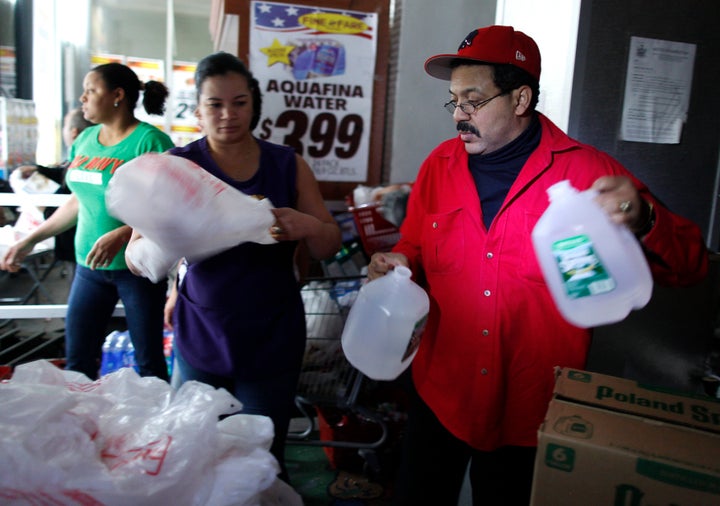
My own interest in this story began with an actual hurricane. Shortly after Hurricane Sandy hit New York City in 2012, I visited the Lower East Side of Manhattan, one of the neighborhoods that had been hardest hit by flooding from the storm. The water had receded by the time I arrived, but the neighborhood already smelled of mold and rot. The power was out; the shops were closed. I saw broken trees, abandoned cars, debris scattered everywhere, people hauling ruined furniture out of basement apartments. I have been writing about climate change for more than a decade, but seeing the flooding on the Lower East Side made it visceral for me.
CARLO ALLEGRI/REUTERS
Workers load bottles of water into bags at Fine Fare in lower Manhattan, New York, in the aftermath of Hurricane Sandy in October 2012.
In the 20th century, the oceans rose nearly 6 inches. But that was before the heat from burning fossil fuels had much impact on Greenland and Antarctica. Today, seas are rising at more than twice the rate they did in the last century. As warming of the Earth increases and the ice sheets begin to feel the heat, the rate of sea-level rise is likely to increase rapidly.
A 2017 report by the National Oceanic and Atmospheric Association, the United States’ top climate science agency, says global sea-level rise could range from about 1 foot to more than 8 feet by 2100. Depending on how much we heat up the planet, it will continue rising for centuries after that.
Although there is still some uncertainty about these forecasts, many scientists I’ve talked to now believe that the high-end projections are likely to increase as they get a better understanding of ice dynamics. Temperature-wise, the trend lines are rising: 2016 was the hottest year on record, and as I’m writing this, the Arctic is more than 45 degrees Fahrenheit warmer than normal.
But if you live on the coast, what matters more than the height of sea rises is the rate at which they rise. If the water rises slowly, people will have time to elevate roads and buildings and build seawalls. Or move away. It is likely to be disruptive but manageable.
Unfortunately, Mother Nature is not always so docile. In the past, the seas have risen in dramatic pulses that coincide with the sudden collapse of ice sheets. After the end of the last ice age, there is evidence that the water rose about 13 feet in a single century. If that were to occur again, it would be a catastrophe for coastal cities around the world.
The best way to save coastal cities is to quit burning fossil fuels. But even if we ban coal, gas and oil tomorrow, we won’t be able to turn down the Earth’s thermostat immediately. For one thing, carbon dioxide is not like other kinds of air pollution, such as the chemicals that cause smog, which go away as soon as you stop dumping them into the sky. A good fraction of the carbon dioxide emitted today will stay in the atmosphere for thousands of years.
Even if we replaced every SUV on the planet with a skateboard and every coal plant with solar panels and could magically reduce global carbon pollution to zero by tomorrow, because of the heat that has already built up in the atmosphere and the oceans, the seas would not stop rising — at least until the Earth cooled off, which could take centuries.
This doesn’t mean that cutting carbon dioxide is pointless. On the contrary. If we can hold the warming to about 3 degrees Fahrenheit above pre-industrial temperatures, we might only face 2 feet of sea-level rise this century, giving people more time to adapt. However, if we don’t end the fossil fuel party, we’re headed for more than 8 degrees Fahrenheit of warming — and with that, all bets are off. 
KEVIN DIETSCH/BLOOMBERG VIA GETTY IMAGES
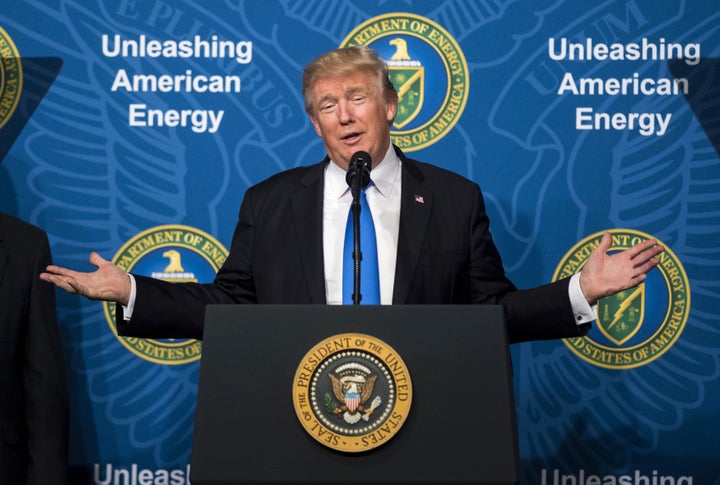
Last year, President Donald Trump said he was lifting an Obama-era policy that curtailed the financing of coal-fired power plants overseas as he sought to reorient the U.S. government away from fighting climate change and toward American “energy dominance.”
We could get 4 feet of sea-level rise by the end of the century — or we could get 13 feet. If we burn all the known reserves of coal, oil and gas on the planet, seas will likely rise by more than 200 feet in the coming centuries, submerging virtually every major coastal city in the world.
The rise will make itself felt in higher storm surges, higher tides, and a gradual washing away of beaches, of roads, of coastal infrastructure. Even in the worst-case scenarios, the changes will occur over years, decades and centuries.
It’s exactly the kind of threat that we humans are genetically ill-equipped to deal with. We have evolved to defend ourselves from a guy with a knife or an animal with big teeth, but we are not wired to make decisions about barely perceptible threats that gradually accelerate over time.
One of the hard truths about sea-level rise is that rich cities and nations can afford to build seawalls, upgrade sewage systems and elevate critical infrastructure. Poor cities and nations cannot. But even for rich countries, the economic losses will be high. One recent study estimated that with 6 feet of sea-level rise, nearly $1 trillion worth of real estate in the U.S. will be underwater, including 1 in 8 homes in Florida.
But it is not just money that will be lost. Also gone will be the beach where you had your first kiss; the mangrove forests in Bangladesh where Bengali tigers thrive; St. Mark’s Basilica in Venice, Italy; NASA’s Kennedy Space Center; the slums of Jakarta, Indonesia; entire nations like the Maldives; and, in the not-so-distant future, Mar-a-Lago, the winter White House of President Donald Trump.
About 145 million people live 3 feet or less above the current sea level. As the waters rise, millions of these people will be displaced, many of them in poor countries, creating generations of climate refugees that will make today’s Syrian war refugee crisis look like a high school drama production.
The real issue here is the complexity of human psychology. At what point will we take dramatic action to cut carbon dioxide pollution? Will we spend billions on adaptive infrastructure to prepare cities for rising waters — or will we do nothing until it is too late? Will we welcome people who flee submerged coastlines and sinking islands — or will we imprison them? No one knows how our economic and political system will deal with these challenges.
The simple truth is, human beings have become a geological force on the planet, with the power to reshape the boundaries of the world in ways we didn’t intend and don’t entirely understand. Every day, little by little, the water is rising, washing away beaches, eroding coastlines, pushing into homes and shops and places of worship. As our world floods, it is likely to cause immense suffering and devastation. It is also likely to bring people together and inspire creativity and camaraderie in ways no one can foresee. Either way, the water is coming.
CORRECTION: A previous version of this story called Mar-a-Lago the summer White House. It is known as the winter White House.
This excerpt has been adapted from The Water Will Come: Rising Seas, Sinking Cities and the Remaking of the Civilized World, published by Black Inc. (£17.99 / AU$34.99) and in the U.S. by Little, Brown ($28.99).