Monday, July 23, 2018

It Takes a Village: Saving the South-Eastern Red-Tailed Black Cockatoo is a Community Ambition

by Daniella Teixeira, Remember the Wild: http://www.rememberthewild.org.au/it-takes-a-village-saving-the-south-eastern-red-tailed-black-cockatoo-is-a-community-ambition/

The Red-tailed Black-cockatoos of Victoria’s south-west are a distinct sub-species, known as the South-eastern Red-tailed Black-cockatoo. Image: Daniella Teixeira

In Victoria’s far south-west, the Red-tailed Black-cockatoo survives in a fragmented landscape of stringybark forests within a matrix of agricultural lands. The birds here are a distinct subspecies of Red-tailed Black-cockatoo, Calyptorhynchus banksii graptogyne or the South-eastern Red-tailed Black-cockatoo, isolated from others of their kind by thousands of kilometres. Their life history is inextricably tied to the landscape of this region, which includes the adjacent areas of South Australia. They feed almost exclusively on the small fruits of stringybark and Buloke, to which their relatively small bills are starkly adapted. They nest most often in the large, deep hollows of very old River Red Gums, many of which were ringbarked in the early 1900s.
Like its fellow Forest Red-tailed Black-cockatoo in Western Australia, the South-eastern Red-tailed Black-cockatoo is endangered. Unlike its counterpart, however, the South-eastern Red-tail hasn’t adapted to any novel food sources, thanks (at least partly) to its small bill. With the population now at about 1,400 birds, the South-eastern Red-tailed Black-cockatoo is one of Australia’s most endangered Black-cockatoos. In terms of having a small population, it is second only to the Kangaroo Island Glossy Black-cockatoo, which sits at around 400 birds (and growing, thanks to an intensive recovery program).
The decline of good quality feeding habitat is thought to be the red-tail’s most significant threat. Buloke has suffered the most severe loss through direct clearing, but the roughly 58% of stringybark that remains in Victoria continues to be threatened by fire. With no sign that the birds can eat anything else, and Buloke being too slow-growing to be planted for short- to medium-term gains, the protection of stringybark is vital to the red-tail’s survival.
I began studying this population of red-tails in early 2016, as part of my PhD research. My project came from the need for better methods to directly monitor breeding, because long-term data collected by the recovery team (a collaboration of scientists, government, non-profit groups, farmers and other stakeholders) suggested a decline in the number of juveniles in the population. Direct nest monitoring by humans had proved unfeasible.
I set out for my first field trip in the spring of 2016 to find as many red-tail nests as I could, my ultimate goal being to develop a way to monitor breeding with nothing but standalone sound recorders. If it worked, this would mean, in practice, that sound recorders at nests could provide us data on breeding behaviour and nest success. To do this, I needed to understand how red-tails behave and vocalise at nests – which meant that I first needed to find lots of nests.
I had planned for months of looking for nests in forests, but I quickly learned that with the help of the farmers who are familiar with red-tails, all my work at nests could be done on private property. In fact, this proved a much more effective approach since almost all known red-tail nests are on private land, because that’s where the big, dead River Red Gums still stand. Engaging with landowners, as it turned out, became the most important tool in my nest-monitoring arsenal. So, while every PhD student dreams of fieldwork in pristine wilderness, I found myself working not in forests but on livestock farms.
Skip forward to 2018 and I have data from nests on farms across a large part of the red-tail’s range. What’s more, the farmers keep an eye on things for me when I can’t be in the field. It’s the collaboration – and enthusiasm – of the farmers along with me and the recovery team that has allowed this project to move forward.
In a broader context, community involvement is key to this bird’s recovery. While conservation actions are guided by the scientists and stakeholders that form the recovery team, the on-ground work relies on the dedicated investment from community members. Each year, volunteers get together to find red-tail flocks so that the recovery team can collect data on population size, demographics, and the flocks’ locations in the landscape that year. This provides the most important long-term monitoring data that we have for the red-tails. Landowners also volunteer their properties for food habitat revegetation and artificial nest hollow installations.
The situation seems bleak for the South-eastern Red-tailed Black-cockatoo. We know that food habitat is being impacted by fire, and we know that natural nest hollows are collapsing. While there is serious cause for concern, optimism arises from the impressive dedication that I’ve witnessed in the red-tail community. If we can better understand how well red-tails breed and where, and then use that knowledge to take actions like revegetation and installing artificial nest boxes on private land, we will have a good chance of promoting better breeding in this endangered population.

Daniella Teixeira’s research was recently featured on an episode of ABC’s Off Track. Make sure you give it a listen here.

Monday, July 16, 2018

Is it Time for a Post-Growth Economy? The growth-driven economic model we have adopted is killing our planet.

by Jason Hickel, Al Jazeera: 
The crowds of protesters that confronted US President Donald Trump during his visit to London last week have channelled the world's outrage at all that he represents. But despite this opposition, Trump's base is expanding. Even those who baulk at his regressive positions - his racism, misogyny, divisiveness - are willing to hold their noses and line up behind him. Why? Because of his promises to deliver growth.
Politicians rise and fall on their ability to grow the GDP. It doesn't matter what it takes, whether it's ripping up environmental protections, gutting labour laws, or fracking for cheap oil: If you achieve growth, you win.
This is only the beginning. As we bump up against the limits of growth - market saturation, resource depletion, climate change - politicians will become increasingly aggressive in their pursuit of it. People like Trump will proliferate because everyone knows that we need growth: if the economy doesn't keep expanding by at least two percent or three percent a year in developed countries, it collapses into crisis. Debts can't be repaid, firms go bust, people lose their jobs. 
The global economy has been designed in such a way that it needs to grow just to stay afloat. We are all hostages to growth, and hostages to those who promise it. 
This is a massive problem because growth is tightly linked to environmental degradation. Growth of three percent may not sound like much, but it means doubling the size of the economy every 20 years - doubling the number of cars, smartphones, air miles... i.e. doubling the waste. Scientists tell us that we have already exceeded key planetary boundaries, and we can see the consequences all around us: deforestation, biodiversity collapse, resource wars and climate change.
The good news is that it doesn't have to be this way. We can choose to create an economy that doesn't require endless growth and thus take the wind out of the sails of politicians like Trump. In fact, it's already happening: scholars and activists around the world are building the foundations for post-growth economics.
WATCH

Turning the tide on plastic: Creation and art from waste

The first step is to challenge the myth that growth is required by society. Economists and politicians tell us that we need growth in order to boost people out of poverty. But of all the new income generated by growth, only five percent goes to the poorest 60 percent of humanity. Growth is an extremely inefficient and ecologically insane way of improving people's lives. We can end poverty much more quickly, without any growth at all, simply by distributing existing income more fairly.
This is the core principle of a post-growth economy: Equity is the antidote to growthThere are lots of ideas about how to get there. We could introduce a global minimum wage and strengthen international labour laws. We could put a maximum cap on income and wealth. We could encourage and even subsidise worker-owned cooperatives so wealth and power are distributed more equally.
But we also need to do something about our structural dependence on growth.
For example, capitalism has a built-in incentive to increase labour productivity - to squeeze more value out of workers' time. But as productivity improves, workers get laid off and unemployment rises. To solve this crisis, governments have to find ways to generate more growth to create more jobs.
There are proven ways to escape this vicious cycle. We could introduce a shorter working week as Sweden has just done, sharing necessary labour so that everyone can have access to employment without the need for perpetual growth. Or we could ease off on the labour requirement altogether by rolling out a universal basic income,funded by progressive taxes on carbon, resource-extraction, and financial transactions.
WATCH

Fighting insectageddon: Why bugs matter

Another reason our economy has to grow is because of debt. Debt comes with interest, and interest is a compound function. Individuals, companies and states have to grow their output simply in order to pay down their debts. We can escape this cycle by cancelling unjust or unpayable debts - maybe usingcitizen debt audits - which would help liberate us from the growth imperative. We could also shift tonew monetary systems that don't have debt and interest built into them from the very start.
In order to help us get back within planetary boundaries, we could introduce new rules that limit the total amount of resources that we consume and waste we produce - much like we have done with CO2 emissions - so that we never extract more than the Earth can replenish or pollute more than our ecosystems can safely absorb.
And of course, we can choose to get rid of GDP as our primary indicator of economic success and embrace saner, more holistic measures, like the Genuine Progress Indicator (GPI), which accounts for the negative ecological and social impacts of economic activity.
Countries as diverse as Bhutan, Scotland, Slovenia, Costa Rica and New Zealand are already embracing alternative measures. When politicians are told to pursue something like GPI instead of GDP, they are incentivised to maximise social goods and minimise ecological "bads". 
All of these ideas would help us transition away from the "growth-at-all-costs" model, and overthrow the tyranny of growth-obsessed politicians. We have a choice to make as a civilisation: either we prioritise growth or we prioritise life. We cannot do both. If we are going to survive the Anthropocene, it will be because we create post-growth economies that allow us to flourish in harmony with this beautiful and generous planet we call home.
The views expressed in this article are the author's own and do not necessarily reflect Al Jazeera's editorial stance.
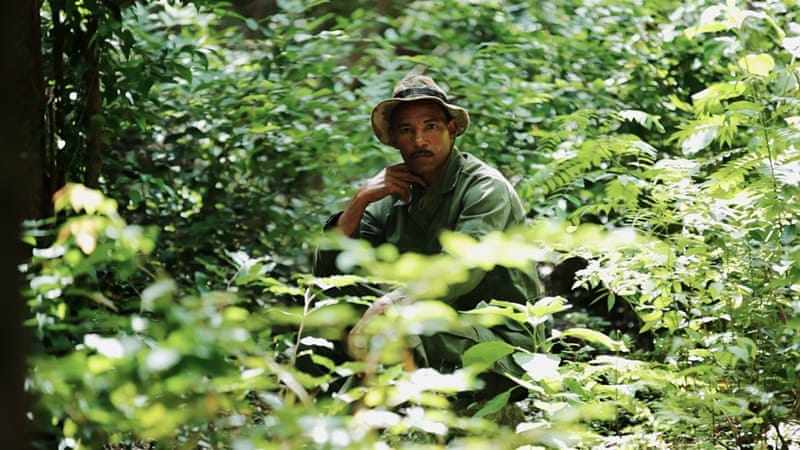
Illegal Deforestation: Death by a Thousand Cuts
WITNESS
Illegal Deforestation: Death by a Thousand Cuts

ABOUT THE AUTHOR