 |
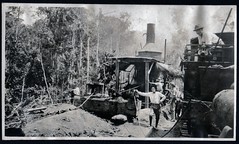
| Logging Operations in the Philippines (Photo credit: A. Davey) |
The last week has seen the authorities place further focus on the importance of clamping down on the illegal logging activities, suggested to be taking place in the Caraga region of the Philippines.
Following the confiscation of 16 million cut logs in Butuan City earlier this month, Department of Interior and Local Government Secretary (DILG), Jesse Robredo, has again reinforced the government's determination to stamp out illegal activity in the region which has had such a significant impact on the sustainable development of genuine logging activities in the country.
Though the logs in question were thought to be owned by Roger Edma, this was denied by the businessman and no charges were brought. In his statement, Robredo confirmed that the DILG had no power to bring a case against Edma and it was discovered that the logs had in fact passed through five Department of Environment and Natural Resources (DENR) checkpoints during transportation, without issue. This was in direct violation of the blanket log ban that is currently in effect on all commercial logs throughout the country.
As a result of this discovery, "show cause orders" have been issued against a number of key personnel inside the DENR as well as the Mayors of Agusan del Sur and Agusan del Norte for their apparent disregard of the activity being undertaken. But the ties between illegal logging and corruption seem to be as strong as ever.
Robredo went on to confirm that the government had been working with national security forces including the Philippine National Police to eliminate illegal activity and enforce existing forestry laws. However, the authorities still seem to be having significant difficulties in curtailing the problem.
In fact, the issues are becoming so engrained that even those reporting on the corruption within the region are now facing death threats for exposing the problems, and national reporters fear for their safety in the Caraga and Northern Mindanao area after recent headline stories were released relating to the Edma case.
As the pressure for further reduction of emissions from deforestation and forest degradation (REDD) are put on the country, it is more important than ever for the Philippines to be able to effectively control the logging processes in the country and eradicate unlawful logging that invalidates the efforts being made to conform with national and international expectations.
Though historically those identified as being involved in such activity in the region have been arrested and charged whenever possible, the recent reports stating that corruption within the government and the police force remains a major factor shows that the problem is still very much present.
While in his statement Robredo confirmed that he intends to use a 'one strike' policy when it comes to any government official or member of the police who has any involvement in such activity and would be personally recommending to President Benigno Aquino III that all participating individuals be instantly dismissed from duty, the progress required to get the Philippines logging industry on track still has a long way to go.
At silvinvest we highlight several superb sustainable Forestry Investments. Register at http://www.silvinvest.co.uk to gain access to the Sales Brochures and interact with our Potential Returns Calculator.
Silvinvest is an information and business development website. It is packed full of interesting articles, research and news regarding ethical investments with environmental benefits. Mostly, we take a very close look at the third biggest commodity traded worldwide, Timber.
Article Source: http://EzineArticles.com/?expert=Ian_R_Harlock
http://EzineArticles.com/?Further-Clampdown-on-Illegal-Logging-in-the-Philippines&id=7185146


