Tuesday, January 20, 2009

Solar Power: A Brief History

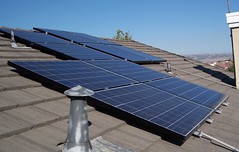
Solar cells on top of roofImage by reiner.kraft via Flickr

A Brief History of Solar Power by Jonathan Gal

Throughout human being's long history, both the recorded and prehistoric periods, the warmth of the sun has been put to use. Early homes were situated in locations that received a great deal of heat and light. Later, methods for distillation of water and cooking of food using only the sun's rays were developed as well. Today, the sun is being regarded as a fundamentally untapped natural resource, and millions of people have begun to explore the remarkable benefits of solar power.

What exactly is solar power? In the simplest of terms, there is energy contained within the intense radiation that comes from the sun. Using a number of materials and systems, scientists, engineers and technicians have created ways in which home and business owners can reduce their supplied energy use through reliance on solar power.

Today solar power is used in many large and small scale applications for everything from heating and cooling of homes and buildings, creating domestic hot water, treating water and sewage, cooking, mass electrical production and even in modes of transportation such as cars and airplanes.

Actual development of the solar cells required to harness the sun's energy in an effective way began in the 1800s when a French physicist observed that there were "photoelectric" effects from the sun. Only one hundred years later photovoltaic effects were being improved, and actually the most commonly used material - cadmium selenide - was being used effectively.

Things really took off from the 1950s onward as silicon and other materials were being put to use for residential and commercial solar applications. It was at this time as well that the gas crisis of the 1970s caused many people to address energy issues beyond the use of oil and petroleum products. At that time many people turned their attention to solar, water and wind as untapped sources of renewable energy.

Today scientists and physicists, among many others, are continuing to expand the applications of solar energy. It is now not uncommon to see an entire roof paneled with photovoltaic cells, or enormous power plants constructed entirely of solar collectors and a single tower for directing the energy into a steam chamber or some other method of converting the light and heat into usable energy.

With all of this research and discovery it has also become much easier to acquire the materials and equipment necessary for outfitting a home or other building with at least one source of solar energy, such as a hot water system. This all means that the days of totally natural energy are getting closer and more affordable for almost any budget.

Jonathan Gal is a solar lighting expert and owner of YCA Solar Light Store, a retailer dedicated to clean, energy efficient solar technology.

Article Source: http://EzineArticles.com/?expert=Jonathan_Gal
http://EzineArticles.com/?A-Brief-History-of-Solar-Power&id=1881880

Reblog this post [with Zemanta]

The Passive House: Eco-Friendly Living

Original Passivhaus, Darmstadt, in winterImage via Wikipedia

Passive Houses, the Best Eco-friendly Homes by Wilson Uche Ukah

With ever-increasing population, coupled with the continued world appetite for more energy, there is a global demand for energy-efficient homes. In response, architects all over the world are designing more sustainable homes that use better insulation and high-efficiency appliances. These designers are also incorporating in their buildings, the use of new sources of power, such as solar panels and wind turbines, which are the icons of the green building. In such a quest for the best eco-friendly homes, passive houses were born.

Passive houses were started in a small town in Germany outside of Frankfurt. The objective of a passive house is to create a warm and comfortable house without energy demand. The goal is accomplished by recycling heating.

Surprisingly, many people in North America are not familiar with them even though they are gaining a lot of following in European countries. As it incredible as it may sound, they use 90% less energy than a traditional house We are talking about paying only 10% of the energy bill that a traditional home is paying.

Just as North America is lagging behind China and some European and Asian countries in internet broadband use, it has yet to wake up to the tremendous energy savings that these inventive homes are providing. The Passivhaus Standard as it is known is much firmer than the Energy Star that many in North America consider an adequate environmental barometer.

Even as President Barack Obama is already being considered as the environmental President by many for his bold initiatives to transform the U.S. as the undisputed leader in the new and growing green economy, many in Europe are way ahead of the curve on passive homes. While the Obama government is poised to overhaul 75% of federal buildings in an effort to save $2 billion through energy efficiency alone, and the funding of green schools, passive homes are little known here.

Best green homes

Passive houses use only 10% of the energy used by conventional homes of comparable size. They use "recycled heat" generated inside the house to heat the home itself. By incorporating ultra-thick insulation and re-engineered doors and windows, the house is sealed so that no heat gets out and no cold air seeps in. They are extremely energy efficient houses that don't need an extensive heating or cooling system like geothermal heating systems or heating boilers.

The house is heated by the sun, but also from the heat from the residents and even appliances in conjunction with an air-heat exchange system to provide fresh air and recycle the heat of outgoing air. In winter, only a back-up heating element of 1kW maximum is recommended. The heating requirement for the U.S. is less or equal to 15kW/sq m. To make sure that a house meets the energy performance standard for passive houses, it is tested with 'blowerdoor' and thermal infrared camera. It is important to note that the building principles used in building passive houses can be transferred to new buildings and retrofits.

There are now an estimated 15,000 passive houses worldwide, most of them being built recently and mostly in Europe. What is holding the U.S. back from this all important leadership role in the green economy?

Wilson Uche Ukah, is the President of Refinishing Stars, a bathtub refinishing company serving the bathtub reglazing needs of homeowners in Atlanta, Chattanooga, Nashville and Knoxville. Refinishing Stars, refinishes bathtubs, sinks, and countertops for hotels and motels nationwide. He writes regularly on green remodeling. Wilson can be reached at: http://www.refinishingstars.com or sales@refinishingstars.com

Article Source: http://EzineArticles.com/?expert=Wilson_Uche_Ukah
http://EzineArticles.com/?Passive-Houses,-the-Best-Eco-friendly-Homes&id=1879719

Reblog this post [with Zemanta]