Wednesday, August 7, 2013

The Media and the Coalition are not Fair Dinkum about Climate Change

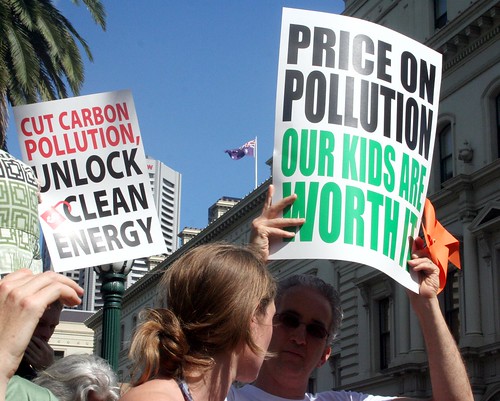
Price the Polluters Rally - Price on pollution our kids are worth itby Brad Farrant, University of Western Australia

Despite a capacity crowd and a stellar cast neither the media nor the Coalition turned up to the climate change election forum in Perth last night.

Liberal MP Dr Dennis Jensen who refutes the scientific consensus was booked in to attend but pulled out.

A concerted effort by the organisers failed to find a single Coalition politician or candidate willing to attend and present their policies. The mainstream media was also conspicuously absent.

Unfortunately this is indicative of how much the media and the Coalition are not fair dinkum about climate change.

Climate change is the biggest global health threat of this century. The Climate Commission has recently reminded us that this is the critical decade for action if we are to prevent dangerous climate change.

Because of the potential to undo previous gains and set national and international efforts on climate change back many years this is shaping up to be the most important election in our children’s futures.

Our politicians and journalists have an ethical duty to ensure that we protect the health and wellbeing of the children of today and tomorrow from dangerous climate change.

Despite the fact that he previously declared that the science behind climate change was “crap” along with his more recent dog whistle to climate science deniers, the fact that his chief business advisor refutes the scientific consensus and that other senior coalition figures continue to deny the science, Tony Abbott now says that the coalition accepts the science and is “fair dinkum” about addressing climate change.

Furthermore, on the weekend Mr Abbott’s message to voters was that the election should be about who they think is more “fair dinkum” and can deliver results instead of being all talk.

This is a remarkable position from a man who ousted former opposition leader Malcolm Turnbull because of the latter’s support for action on climate change.

At the time Malcolm Turnbull said that the “Liberal Party is currently led by people whose conviction on climate change is that it is “crap” and you don’t need to do anything about it. Any policy that is announced will simply be a con, an environmental figleaf to cover a determination to do nothing.”

Whether you believe Malcolm or not, few would dispute that Tony Abbott’s tactics since his elevation to opposition leader have played a major role in decreasing public support for action on climate change as well as the government’s recent axing of the ‘carbon tax.’

Over the last 24 hours the mainstream media has once again uncritically reported Tony Abbott’s assertion that this election is about the ‘carbon tax.’ This has been given massive coverage in all forms of media.

How is it that Mr Abbott can make the election about climate change policy and yet largely avoid rigorous journalistic analysis of his own climate change policy?

The opposition’s direct action plan has been criticised by experts ever since it was announced with 85% of economists saying that the direct action plan is not sound economic policy and few believing it will actually work.

More recently a number of separate analyses have also highlighted the major inadequacies in the opposition’s direct action plan.

Although the existing government policies fall well short of committing Australia to do its fair share to prevent dangerous climate change, the opposition’s policies are far worse and only stand because the media is abetting them.

With a handful of notable exceptions (see the links in this piece for some examples) the Australian media is failing to inform the public about the urgency of action that is required to protect the children of today and tomorrow from dangerous climate change or of the relative merits of the policies being put forward in this election.

Brad Farrant does not work for, consult to, own shares in or receive funding from any company or organisation that would benefit from this article, and has no relevant affiliations.
The Conversation

This article was originally published at The Conversation. Read the original article.

Monday, August 5, 2013

Marine Life Spawns Sooner as our Oceans Warm

by Anthony Richardson, CSIRO and Elvira Poloczanska, CSIRO

Warming oceans are affecting the breeding patterns and habitat of marine life, according to a three-year international study published today in Nature Climate Change. This is effectively re-arranging the broader marine landscape as species adjust to a changing climate.

Scientific and public attention to the impacts of climate change has generally focused on how biodiversity and people are being affected on land.

In the last Intergovernmental Panel on Climate Change (IPCC) report in 2007, less than 1% of the synthesis information on impacts of climate change on natural systems came from the ocean.

Yet marine systems cover 71% of Earth’s surface, and we depend on marine life for food, recreation and half the oxygen we breathe.

A key unanswered question is whether marine life is buffered from climate change because of the much more gradual warming in our surface oceans - about one-third as fast as on land.

What’s happening in our oceans?

An international team of scientists from Australia, USA, Canada, UK, Europe and South Africa, and funded by the US National Center for Ecological Analysis and Synthesis, set out to answer this question.

They conducted the first global analysis of climate change impacts on marine life, assembling a large database of 1,735 biological changes from peer-reviewed studies.

Are changes in marine life consistent with climate change? (Elvira Poloczanksa)

Just as the medical profession pools information on the symptoms of individual patients from surgeries and hospitals to reveal patterns of disease outbreaks, we pooled information from many studies to show a global fingerprint of the impact of recent climate change on marine life.

Changes were documented from studies conducted in every ocean, with an average timespan of 40 years.

Although there is a perception in the general public that impacts of climate change are an issue for the future, the pervasive and already observable changes in our oceans are stunning.

Climate change has already had a coherent and significant fingerprint across all ecosystems (coastal to open ocean), latitudes (polar to tropical) and trophic levels (plankton to sharks).

These fingerprints show that warming is causing marine species to shift where they live and alter the timing of nature’s calendar. In total, 81% of all changes were consistent with the expected impacts of climate change.

Moving poleward, breeding earlier

As temperatures warm, marine species are shifting their geographic distribution toward the poles. Most intriguingly, though, they are doing so much faster than their land-based counterparts.

The leading edge or front-line of marine species distributions is moving toward the poles at an average of 72 km per decade - considerably faster than species on land that are moving poleward at an average of 6 km per decade.

Plankton and bony fish, many of which are commercially important, showed the largest shifts.


Giant Rock Barnacle (Austromegabalanus nigrescens) expanding on east coast of Tasmania (E Poloczanska)

Warmer temperatures are also changing the timing of breeding, feeding, and migration events. For marine life, their spring events have advanced by more than four days, nearly twice the figure for land.

The strength of response varied among species, but again, the research showed the greatest response - up to 11 days in advancement - was for plankton and larval bony fish.

Currents clearly play a role in the large distribution movements seen in the ocean, but there is a more-subtle phenomenon is also at work. Temperature gradients are more gentle in the ocean than over much of the land, and this has important implications for species movement.

Consider the complex topography on land. Many land plants and animals only need to move short distances up or down mountains to reach different temperature regimes.

As the ocean surface is relatively flat, marine plants and animals must move greater distances to keep up with their preferred environments as oceans warm.

Seasonal cycles are also dampened in the ocean, meaning that for a set amount of warming, marine species need to shift their timing much earlier than on land.

Australian effect

Although the study reported global impacts, there is strong evidence of change in the Australian marine environment. Australia’s south-east tropical and subtropical species of fish, molluscs and plankton are shifting much further south through the Tasman Sea.

In the Indian Ocean, there is a southward distribution of sea birds as well as loss of cool-water seaweeds from regions north of Perth.

Some of the favourite catches of recreational and commercial fishers are likely to decline, while other species, not previously in the area, could provide new fishing opportunities.

Essentially, these findings indicate that changes in life events and distribution of species indicates we are seeing widespread reorganisation of marine ecosystems, with likely significant repercussions for the services these ecosystems provide to humans.


The Tasman Sea is rapidly warming (Elvira Poloczanska)

Anthony Richardson receives funding from a range of research agencies, including ARC, DIISTRE, DSEWPAC.

Elvira Poloczanska does not work for, consult to, own shares in or receive funding from any company or organisation that would benefit from this article, and has no relevant affiliations.
The Conversation

This article was originally published at The Conversation. Read the original article.